The Difference Between Greening Out and THC Panic Attack: What You Need to Know
Nearly 1 in 5 cannabis users will experience a distressing reaction at some point, yet most people have no idea whether what they’re going through is a physical crisis, a mental health episode, or both. comprehending the difference between greening out and a THC panic attack could be the most important thing you read today, especially as cannabis products grow stronger and more widely available across New York.
These two experiences are often confused, and that confusion matters. One is primarily a physical overdose response. The other is primarily a psychological anxiety reaction. Both are real, both are scary, and both can be warning signs of a deeper relationship with cannabis that deserves attention.
Learn more with Expert Support for Substance Use in Brooklyn, NY.
Key Takeaways 🌿
- Greening out = a physical cannabis toxicity response (nausea, vomiting, dizziness, pallor)
- THC panic attack = a psychological anxiety response (racing heart, fear, derealization)
- Both can happen at the same time, making them easy to confuse
- Neither is a sign of weakness, both can signal problematic cannabis use
- Professional support is available, effective, and nothing to be ashamed of
Comprehending the Difference Between Greening Out and THC Panic Attack
What Is “Greening Out”?
“Greening out” is informal slang for what clinicians classify as acute cannabis intoxication or an adverse reaction to cannabis. It happens when someone consumes more THC than their body can comfortably process, essentially a cannabis overdose, though not typically life-threatening.
Common physical symptoms include:
- 🤢 Nausea and vomiting
- 😰 Profuse sweating and clamminess
- 😶 Pale or greenish skin tone
- 💫 Dizziness and loss of balance
- 🫀 Rapid or irregular heartbeat
- 🥴 Feeling faint or losing consciousness briefly
The person may feel physically terrible but may not be overwhelmed by fear. They often just want to lie down, stop moving, and wait it out. The body is reacting to a chemical overload, not necessarily a psychological spiral.
Greening out is more common with:
- Edibles (delayed onset leads to accidental overconsumption)
- High-potency concentrates or dabs
- First-time or low-tolerance users
- Mixing cannabis with alcohol
What Is a THC Panic Attack?
A THC panic attack is clinically described as a cannabis-induced anxiety disorder, a panic attack triggered or intensified by THC. Unlike greening out, the dominant experience here is overwhelming psychological fear, not primarily physical illness.
Common symptoms include:
- 😱 Intense, sudden terror or sense of doom
- ❤️ Racing or pounding heartbeat (palpitations)
- 😮💨 Shortness of breath or feeling smothered
- 🧠 Derealization (“this isn’t real”) or depersonalization
- 😨 Fear of dying or “going crazy”
- 🤲 Trembling, tingling, or numbness
THC is known to amplify the brain’s threat-detection systems. In people with underlying anxiety, a genetic predisposition, or past trauma, even a moderate dose can flip a switch from relaxed to terrified within minutes.
Side-by-Side Comparison: Greening Out vs. THC Panic Attack
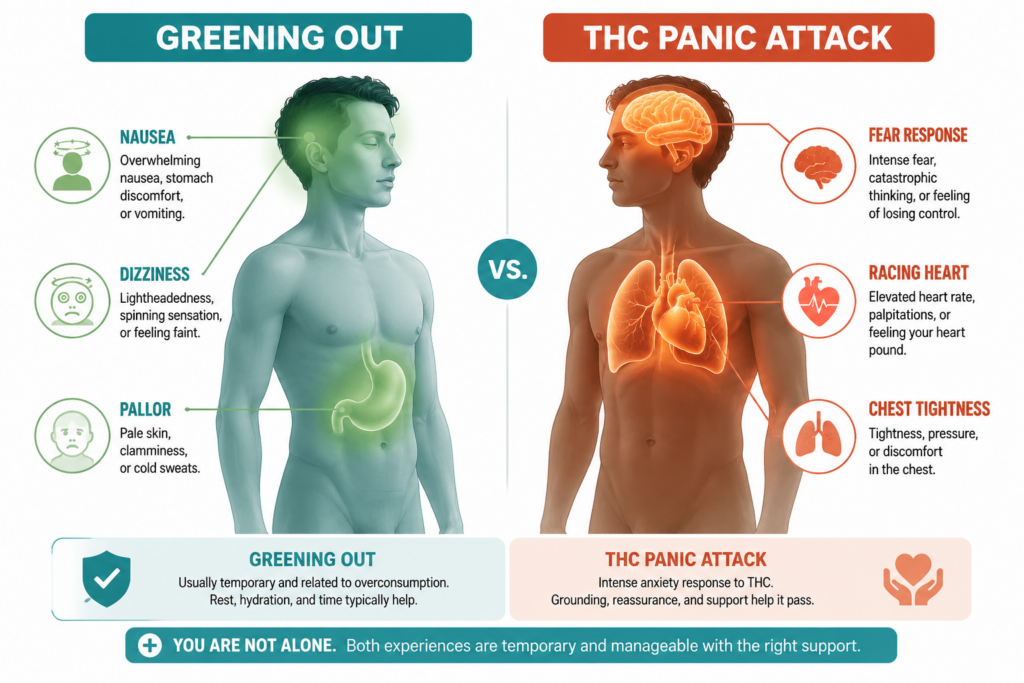
| Feature | Greening Out | THC Panic Attack |
|---|---|---|
| Primary nature | Physical / physiological | Psychological / emotional |
| Main complaint | Nausea, dizziness, vomiting | Fear, doom, derealization |
| Heart racing? | Sometimes | Very common |
| Vomiting? | Very common | Rare |
| Pale/sweaty skin? | Yes | Less typical |
| Sense of terror? | Mild or absent | Severe |
| Clinical term | Cannabis intoxication | Cannabis-induced anxiety disorder |
| Can they overlap? | ✅ Yes, frequently | ✅ Yes, frequently |
Can Both Happen at Once?
Yes, and this is where things get complicated. Many people experience both simultaneously. The physical misery of greening out can trigger panic, and the psychological spiral of a panic attack can worsen physical symptoms like nausea and heart rate. When they overlap, it can feel like a complete breakdown of mind and body.
This overlap is one reason why knowing how substance abuse can lead to mental illness is so important. Cannabis use can genuinely alter anxiety thresholds over time.
Why This Distinction Matters for Your Health
The Risk of Dismissing Either Experience
Both greening out and THC panic attacks are often brushed off as “just weed”, a dangerous minimization. Here’s why both deserve serious attention:
Greening out signals:
- Your body’s tolerance and physical limits are being exceeded
- You may be using higher-potency products than your system can handle
- Repeated episodes can indicate escalating use patterns
THC panic attacks signal:
- Your brain’s anxiety response may be dysregulated
- You may have an underlying anxiety disorder being masked or worsened by cannabis
- Cannabis may be functioning as a coping mechanism for unaddressed stress or trauma
If you’re regularly experiencing either, it’s worth exploring the stages of substance use to understand where your relationship with cannabis currently stands.
When Cannabis Use Becomes a Co-Occurring Issue 🔍
For many people, cannabis use doesn’t exist in a vacuum. It often co-occurs with anxiety disorders, depression, PTSD, or other mental health conditions. This is sometimes called a dual diagnosis or MICA (Mentally Ill Chemical Abuser) presentation.
Comprehending what MICA means in mental health can help people recognize that their cannabis-related distress may be part of a larger picture that deserves integrated, compassionate care.
What to Do During a Greening Out or THC Panic Attack
Immediate Steps for Greening Out
- Stop consuming, no more cannabis, no alcohol
- Lie down in a safe, quiet space
- Hydrate slowly, small sips of water or juice
- Eat something light if possible (sugar can help)
- Stay with someone you trust
- Call 911 if the person loses consciousness or can’t be roused
Immediate Steps for a THC Panic Attack
- Ground yourself, name 5 things you can see, 4 you can touch
- Breathe slowly, inhale for 4 counts, exhale for 6
- Remind yourself, “This is THC. It will pass. I am not dying.”
- Move to a calm environment, reduce stimulation
- Talk to someone, a calm, trusted voice helps enormously
- Seek emergency care if symptoms don’t subside or feel medically serious
The Difference Between Greening Out and THC Panic Attack: Long-Term Patterns to Watch
When Occasional Episodes Become a Pattern
A single bad experience with cannabis doesn’t define your relationship with it. But when these episodes happen repeatedly, or when you find yourself using cannabis to manage anxiety that cannabis itself is worsening, that cycle is worth examining honestly.
Signs that a pattern may be developing:
- Using cannabis daily to feel “normal” or calm
- Needing more to get the same effect (tolerance)
- Greening out more than once
- Panic attacks that happen even when sober
- Using cannabis to cope with trauma, stress, or emotional pain
Cannabis Detox: What to Expect
If you’ve decided to take a break or stop altogether, it helps to know what the process looks like. Knowing how long it takes to detox from cannabis can reduce anxiety about the withdrawal process and help you plan with realistic expectations.
Getting Support in Brooklyn: You Don’t Have to Figure This Out Alone

If any of this resonates, whether you’ve had a frightening greening out episode, recurring THC panic attacks, or you’re just questioning your relationship with cannabis, support is closer than you think.
At LSA Recovery Inc., we offer compassionate, stigma-free outpatient treatment for cannabis use and co-occurring mental health conditions across three Brooklyn locations:
- 📍 Midwood (Kings Highway): 1623 Kings Hwy, Brooklyn, NY 11229, ☎️ (718) 954-3800
- 📍 Crown Heights: 921 E New York Ave, Brooklyn, NY 11203, ☎️ (718) 684-7774
- 📍 Coney Island: 2846 Stillwell Ave, Brooklyn, NY 11224, ☎️ (718) 975-2252
Our MICA program is specifically designed for people navigating both substance use and mental health challenges, because those two things almost always travel together. We also offer individual, family, and group counseling, substance use education, and care management to support every dimension of your recovery.
Same-day appointments are available. Telehealth options are available. Medicaid, Medicare, and most insurances accepted, and our insurance representatives can help if you’re still in the process of getting coverage.
FAQs:
Can greening out cause lasting physical harm?
In most cases, greening out resolves on its own within a few hours without permanent physical damage. Nonetheless severe vomiting can lead to dehydration, and in rare cases, very high THC doses have been associated with cannabinoid hyperemesis syndrome (CHS) a condition involving cyclical, severe vomiting. If symptoms are extreme or don’t resolve, seek emergency medical care.
Does having a THC panic attack mean I have an anxiety disorder?
Not necessarily, but it’s worth exploring. THC can trigger panic responses even in people without a clinical anxiety disorder, especially with high-potency products. Nevertheless, if panic attacks happen frequently, occur outside of cannabis use, or significantly disrupt your daily life, a proper mental health evaluation is strongly recommended.
Is cannabis use disorder a real diagnosis?
Yes. Cannabis use disorder (CUD) is a recognized clinical diagnosis in the DSM-5. It involves continued cannabis use despite negative consequences, tolerance, withdrawal symptoms, and difficulty cutting back. It exists on a spectrum from mild to severe. Recognizing it is not about shame, it’s about accessing the right level of support.
How do I know if I need professional help for cannabis-related anxiety?
Consider reaching out if: your cannabis use feels out of control, you’re using it primarily to manage anxiety or emotional pain, you’ve had multiple greening out or panic episodes, or your mental health has worsened alongside your use. You don’t need to hit a “rock bottom” to deserve support.
References
- Substance Abuse and Mental Health Services Administration (SAMHSA). (2023). Key substance use and mental health indicators in the United States: Results from the 2022 National Survey on Drug Use and Health. U.S. Department of Health and Human Services. https://www.samhsa.gov/data/report/2022-nsduh-annual-national-report
- National Institute on Drug Abuse (NIDA). (2024). Cannabis (marijuana) DrugFacts. National Institutes of Health. https://nida.nih.gov/publications/drugfacts/cannabis-marijuana
- Centers for Disease Control and Prevention (CDC). (2023). Health effects of marijuana. U.S. Department of Health and Human Services. https://www.cdc.gov/marijuana/health-effects/index.html
- American Psychiatric Association. (2022). Diagnostic and statistical manual of mental disorders (5th ed., text revision). https://www.psychiatry.org/psychiatrists/practice/dsm
- National Alliance on Mental Illness (NAMI). (2023). Marijuana and mental health. https://www.nami.org/About-Mental-Illness/Common-with-Mental-Illness/Substance-Use-Disorders