Your First MAT Visit: What to Expect and How to Prepare
By the LSA Recovery editorial team
What Is Medication-Assisted Treatment and How Does It Work?
Medication-Assisted Treatment (MAT) is a whole-person approach to recovery from opioid or alcohol use disorder. It combines FDA-approved medications with counseling and support services to help you reduce cravings, manage withdrawal, and focus on rebuilding your life. MAT is not about replacing one drug with another, it’s a proven, evidence-based tool that helps stabilize your brain chemistry so you can heal. At LSA Recovery, our care team works with you to design a treatment plan that meets your unique needs, whether you’re just starting or have been in recovery before.
The first step is a thorough Substance Use Assessment, where we learn about your history, health, and goals. This is a conversation, not a test, no judgment, just understanding. Then, based on that assessment, we discuss medication options like buprenorphine, methadone, or naltrexone, and explain how each works to reduce cravings and block the effects of opioids or alcohol. MAT is most effective when paired with counseling, care management, and other supports, like individual and family therapy, group sessions, and help with housing or employment. That’s why we offer wrap-around services from the very beginning, including same-day appointments for those ready to take that first step.
- Medication works by calming the brain’s reward system, reducing withdrawal symptoms and cravings without making you feel high.
- Counseling and support (like individual, family, and group therapy) help you address the underlying causes of substance use and build new coping skills.
- Care management and case coordination ensure you have access to medical care, housing, vocational rehabilitation, and other resources.
- MAT is a long-term strategy, recovery is a journey, and your treatment plan can be adjusted over time as your needs change.
- Research shows that MAT reduces the risk of overdose, improves treatment retention, and helps people rebuild their lives. (Source: SAMHSA, NIDA)

What Happens During Your First MAT Visit: A Step-by-Step Guide
Now that you have a clear picture of what MAT is, let’s walk through what happens during your first visit. Starting medication-assisted treatment (MAT) is a brave step toward recovery. Your first visit is designed to be welcoming and thorough. You will meet with our care team for a Substance Use Assessment to understand your history and goals. This is not a test, it's a conversation to help us tailor a plan that works for you. We know that reaching out can feel intimidating, but our team is here to listen without judgment.
During the visit, a medical provider will review your health and discuss medication options like buprenorphine, methadone, or naltrexone. These medications are proven tools that help reduce cravings and withdrawal symptoms, allowing you to focus on healing. You will also talk about counseling and other supports that are part of MAT. Many people worry about side effects or being on medication long-term, but our team will answer all your questions and work with you to find the right approach. If you are ready to start today, we offer Same-Day Appointment so you don't have to wait. To help you prepare, here are a few things to bring:
MAT is most effective when combined with counseling and wrap-around services. Our Individual, Family & Group Counseling can help you build coping skills and strengthen relationships. We also provide care management, MICA program, vocational rehabilitation, and family support programs. According to SAMHSA, medications for substance use disorders are a key part of recovery. Recovery is a journey, and we are with you every step.
- A valid ID and insurance card (if you have insurance)
- A list of any medications you are currently taking
- Any questions you have
Common Fears and Concerns About Starting MAT
How to Prepare for Your First Appointment
Taking the step to schedule your first medication-assisted treatment (MAT) appointment is a brave and important decision. At LSA Recovery, we want you to feel as calm and prepared as possible when you walk through our doors. Your first visit is not a test or a judgment, it is a conversation. You will meet with our care team, who will listen to your story, learn about your goals, and work with you to create a plan that fits your life. MAT combines FDA-approved medications with counseling and support to help people reduce or stop using substances like opioids or alcohol. It is an evidence-based approach backed by research from SAMHSA and NIDA, and it is not a crutch, it is a tool that helps your brain heal so you can focus on your recovery.
Here is what you can expect during your first visit, step by step. When you arrive, you will check in and meet with a member of our team for a substance use assessment. This is a private, respectful conversation where we ask about your substance use history, health, and what you hope to get from treatment. There is no shame here, we ask these questions so we can match you with the right care. After the assessment, a clinician will review your medical history and discuss medication options with you. Depending on your needs, these may include buprenorphine, methadone, or naltrexone. Each option works differently, and our team will explain how they can help reduce cravings and withdrawal symptoms. Together, you will create a treatment plan that may also include individual, family, and group counseling, care management, and other support services like our MICA program for those with co-occurring mental health concerns. If you are feeling anxious or unsure, that is completely normal, our staff is here to answer every question you have, no matter how small.
- Bring a form of ID (like a driver’s license or state ID) and your insurance card if you have one, but do not worry if you do not have insurance; we can help you explore options.
- Write down any medications you are currently taking, including over-the-counter drugs and supplements, so our team has a full picture of your health.
- Come with an open mind, there are no wrong questions, and we want you to feel informed and comfortable.
- If you are ready to start today, ask about our same-day appointment option so you can begin your journey without delay.
- Know that you do not have to do this alone, we also offer family support through programs like ACRA & CRAFT, and our care management team can help connect you to additional resources like vocational rehabilitation or health education groups.
The Role of Counseling and Wrap-Around Support in MAT
Medication is a powerful tool in recovery, but it works best when paired with counseling and other forms of support. Think of it like building a house: the medication provides a stable foundation, and counseling, care management, and other services help you build the walls, roof, and everything that makes that house a home. At LSA Recovery, our care team works with you to create a plan that addresses not just your substance use, but your whole life, your relationships, your health, your goals, and the challenges you face every day.
During your first MAT visit, you’ll talk with a counselor about what’s going on in your life. This isn’t about being judged or told what to do. It’s about understanding your story and finding the right supports. That might include Individual, Family & Group Counseling to help you and your loved ones heal together, or Care Management to coordinate medical appointments, housing, or benefits. If you’re dealing with both substance use and a mental health condition, our MICA Program offers integrated support. And if you’re involved with the criminal justice system or have a DWI, we have specialized programs like Criminal Justice Counseling and our DWI Program to help you meet requirements while moving forward.
Recovery also means rebuilding your life outside of treatment. Our Vocational & Educational Rehabilitation program can help you get back to work or school. Family support is available through ACRA & CRAFT, which gives your loved ones tools to support you in a positive way. And if you ever feel overwhelmed, our Crisis Management team is here to help you through tough moments without judgment. All of these wrap-around services are part of your MAT experience, because recovery is about more than just taking medication. It’s about creating a life you don’t want to escape from.
- Counseling helps you understand patterns, cope with stress, and build healthier relationships.
- Care management connects you to resources like housing, medical care, and insurance.
- MICA support addresses both substance use and mental health together.
- Vocational rehab helps you return to work or school with confidence.
- Family programs like ACRA & CRAFT give your loved ones a role in your recovery.
- Crisis management is available anytime you need extra support.
MAT as a Long-Term Journey: What Recovery Looks Like Over Time
Medication-assisted treatment (MAT) is not a quick fix, it’s a steady, evidence-based path that many people walk for months or years. Over time, the medication helps stabilize your brain chemistry, reduce cravings, and block the pleasurable effects of opioids or alcohol, so you can focus on rebuilding your life. Recovery isn’t a straight line; it’s a journey with ups and downs, and MAT gives you a solid foundation to work from. Our care team is here to support you at every stage, adjusting your treatment plan as your needs change.
As you move forward, the support you receive goes beyond the medication. Our care management team helps you coordinate medical appointments, housing, and other practical needs. Counseling, whether individual, family, or group, gives you a space to address the emotional and relational parts of recovery. For those with a dual diagnosis, our MICA program (for those with both mental health and substance use challenges) provides integrated care. And when you’re ready, our vocational and educational rehabilitation services can help you get back to work or school. Programs like ACRA and CRAFT also offer specific support for you and your family, because recovery is stronger when everyone is involved.
Over time, many people find that the cravings and triggers that once felt overwhelming become more manageable. You may still face tough moments, but you’ll have tools and a community to lean on. Some people stay on MAT for years; others eventually taper off under medical supervision. There’s no right or wrong timeline, only what works for you. The goal is not just to stop using, but to build a life that feels meaningful and stable. Reach out to us anytime; we’re here for the long haul.
- Your medication dose may be adjusted over time based on how you’re feeling and your recovery goals.
- You’ll have regular check-ins with your care team to monitor progress and address any new challenges.
- Many people find that their relationships improve as they become more present and reliable.
- You can participate in education groups, like our health education or substance abuse education programs, to learn more about maintaining wellness.
- If you ever feel a crisis coming on, our crisis management team is available to help you through it.
Getting Started: How to Access Care and What About Cost?
Taking the first step toward medication-assisted treatment (MAT) can feel like a big unknown. Maybe you’re worried about what will happen at the first visit, or you’re concerned about the cost. Let’s walk through it together, so you know exactly what to expect and how to make it as smooth as possible.
Your first MAT visit starts with a simple conversation. You’ll meet with our care team for a substance use assessment, a friendly, no-pressure chat about your history, your health, and what you hope to achieve. This is not a test or a judgment. We’ll ask about the substances you use, any past treatment, and your medical history. Bring a list of any medications you take, your ID, and insurance information if you have it. If you don’t have insurance, don’t worry, we’ll help you figure out options. Many people can start the same day through our same-day appointment option, so you don’t have to wait.
Cost is a common worry, but we work hard to remove barriers. We accept most insurance plans, including Medicaid and Medicare, and we offer sliding-scale fees based on what you can afford. Our care management team can help you apply for coverage or connect you with other resources. The goal is to make treatment accessible, not to add stress. After the initial assessment, we’ll discuss medication options like buprenorphine, methadone, or naltrexone, all evidence-based tools that help reduce cravings and withdrawal, so you can focus on your recovery. You’ll also learn about the counseling and support services that are part of MAT, because medication works best when combined with care. For more details on what we offer, you can always contact us.
- What to bring: a photo ID, insurance card (if you have one), and a list of any medications you take.
- What to expect: a private, respectful conversation with our staff, a medical review, and a discussion of medication options that fit your needs.
- What it costs: we accept most insurance and offer sliding-scale fees. Our team can help you find coverage if you’re uninsured.
- How to start: call us or walk in for a same-day appointment, no referral needed, no judgment.
Support for Family Members and Loved Ones
If you are a family member or loved one of someone starting medication-assisted treatment (MAT), you may have your own questions and worries. It is common to feel unsure about how to help, what to say, or whether the treatment will work. You are not alone in this, and your support can make a real difference in your loved one’s recovery journey. At LSA Recovery, we offer programs specifically designed for families, including ACRA & CRAFT, which are programs designed to help families support their loved one's recovery in positive ways. Our care team can also connect you with individual, family & group counseling, where you can talk openly about your concerns in a safe, non-judgmental space. Remember, substance use disorder is a health condition, not a moral failing, and your role is not to fix everything but to be a source of steady, caring support.
Many families also benefit from our ACS (family support) program, which provides guidance for parents and caregivers involved with child welfare or simply seeking to strengthen their family bonds. You might also find it helpful to attend a substance abuse education group or health education group to learn more about what your loved one is experiencing. If you ever feel overwhelmed, our crisis management team is here to help you navigate tough moments. Taking care of yourself is just as important as supporting your loved one, and reaching out for your own support is a sign of strength. To learn more about how we can help your family, please contact us or visit our about us page.
- Ask your loved one how you can best support them, every person’s needs are different.
- Learn about MAT and recovery so you can understand what your loved one is going through.
- Attend family counseling or a support group to share experiences and get guidance.
- Set healthy boundaries and practice self-care, you cannot pour from an empty cup.
- Celebrate small steps forward, and be patient with setbacks, recovery is a process.
More Ways We Can Help
- Our Philosophy
- About Us
- Contact Us
- Substance Abuse Education
- Health Education Groups
- HIV/AIDS Education
- ACS (Family Support)
- Naloxone Training and Kits
When to Seek Care Right Away
- Signs of an overdose: the person cannot be woken, breathing is slow or has stopped, or the lips and fingertips look blue or grey. Call 911 immediately and give naloxone if it is available.
- Thoughts of suicide or self-harm, or feeling unable to stay safe. Call or text 988 for the Suicide and Crisis Lifeline.
- Chest pain, a racing or irregular heartbeat, trouble breathing, or fainting.
- Withdrawal from alcohol or benzodiazepines with shaking, confusion, hallucinations, or a seizure. This can be life threatening and needs emergency care rather than stopping on your own.
- Repeated vomiting, being unable to keep fluids down, or a high fever during withdrawal.
Sources
- SAMHSA: Medications for Substance Use Disorders
- NIDA: Medications to Treat Opioid Use Disorder
- FindTreatment.gov
If you or someone you know is struggling with substance use, thinking about suicide, or in crisis right now, help is available. Call or text 988 to reach the 988 Suicide & Crisis Lifeline, or call the SAMHSA National Helpline at 1-800-662-4357 (1-800-662-HELP) for free, confidential, 24/7 treatment referral and information in English and Spanish. You can also search for local treatment options anytime at FindTreatment.gov. You are not alone, and reaching out is a sign of strength.
Disclaimer: This article is for general educational purposes only and is not a substitute for professional mental-health, medical, or crisis care. Always seek the advice of a qualified clinician or care provider with any questions you may have about a specific mental-health, behavioral, or substance-use concern. If you are in crisis, see the resources below.
Crisis Management and Insurance in Brooklyn: Getting the Help You Need Without Worrying About Cost
By the LSA Recovery editorial team
What Is Crisis Management and How Can It Help?
Crisis management is a short-term, focused support service designed to help you or someone you care about get through a difficult moment safely. It offers a calm, non-judgmental space where you can talk through what is happening right now, get connected to the right resources, and find a path forward. At LSA Recovery in Brooklyn, our care team provides crisis management as part of a broader commitment to meeting people where they are, without shame or judgment.
When you reach out for crisis management, you are not alone. Our staff will listen to your concerns, help stabilize the situation, and work with you to create a plan that fits your life. This might include connecting you to a Substance Use Assessment to understand what kind of support you need, or linking you to Medication-Assisted Treatment if that is a good fit. We also offer Individual, Family & Group Counseling to address the emotional and relational side of what you are going through. The goal is always to help you feel safe, heard, and supported.
Crisis management also serves as a bridge to longer-term care. Our Care Management team can help you navigate insurance, appointments, and other practical steps. For those needing extra support, we offer programs like the MICA Program for people dealing with both substance use and mental health challenges, and Criminal Justice Counseling for those involved with the legal system. No matter what brings you to us, crisis management is a way to pause, breathe, and take the first step toward stability.

When to Reach Out: Signs a Crisis Is Happening
A crisis can feel different for everyone, but there are common signs that it is time to reach out for support. You may feel overwhelmed, hopeless, or like you are losing control. Maybe you are having thoughts of hurting yourself or someone else, or experiencing severe withdrawal symptoms that make it hard to function. Perhaps you have witnessed an overdose or worry about one happening. These are all signs that a crisis is happening, and you do not have to face it alone. Reaching out is a sign of strength, and help is available right now.
At LSA Recovery, our Crisis Management services are designed to meet you where you are. When you are in crisis, worrying about cost should not be a barrier. Most insurance plans, including Medicaid, Medicare, and private insurance, cover crisis management services, and our team can help you understand your coverage. If you are unsure about your coverage or lack insurance, our team can help you verify benefits, offer sliding scale fees, and assist with enrollment. We also provide Same-Day Appointment so you can get support without delay.
A Substance Use Assessment can help us understand your unique situation and connect you with the right level of care, whether that is Medication-Assisted Treatment, Individual, Family & Group Counseling, or other support. The goal is to ensure cost never stands between you and the help you need.
- Feeling out of control, hopeless, or like you might hurt yourself or others
- Experiencing severe withdrawal symptoms or worrying about an overdose
- Having thoughts of suicide or self-harm, the 988 Suicide & Crisis Lifeline is available 24/7
- Not knowing where to turn for help with substance use or mental health
- Worrying about how to pay for care, most insurance covers crisis management, and LSA Recovery can help regardless of your situation
What Crisis Support Looks Like at LSA Recovery
Crisis management at LSA Recovery is a safe, non-judgmental service for moments of intense distress related to substance use or mental health. Our care team is trained to respond with compassion and practical support, whether you are experiencing a panic attack, suicidal thoughts, or a substance use crisis. We offer Same-Day Appointment so you do not have to wait for help, and we work with most insurance plans to make sure cost is not a barrier.
Many people worry about insurance coverage, but laws that promote equal coverage for mental health and substance use care mean that most plans include crisis management. If you are uninsured or have a high deductible, LSA Recovery offers sliding scale fees and our Care Management team can help you explore options, including enrolling in insurance. A Substance Use Assessment is often the first step to understand your needs and connect you with the right support.
Crisis support connects to a larger continuum of care. After a crisis, you may benefit from Medication-Assisted Treatment, family support programs like ACS and ACRA & CRAFT, or Naloxone Training and Kits to keep yourself and others safe. Remember, reaching out during a crisis is a sign of strength, and our team is here to support you regardless of your financial situation.
- Call your insurance provider to ask about coverage for crisis management services.
- Contact LSA Recovery for a free benefits check and to learn about sliding scale fees.
- If you are uninsured, ask about enrolling in insurance through our Care Management team.
How to Access Crisis Care in Brooklyn
If you are in crisis, the last thing you need to worry about is whether you can afford help. Crisis management services are covered by most insurance plans, including Medicaid, Medicare, and private insurance. At LSA Recovery, we accept a wide range of plans and our team can help you verify your benefits quickly. We also offer Same-Day Appointment so you can get support without waiting. If you are unsure about your coverage, call us or visit our Contact Us page, and we will guide you through the process.
If you do not have insurance or have a high deductible, you still have options. LSA Recovery offers sliding scale fees based on your income, and our Care Management team can help you enroll in insurance or connect you with other resources. We believe that no one should be turned away because of cost. Our crisis management services are a safe, non-judgmental space where you can talk about what is happening and get connected to the right support, whether a Substance Use Assessment, Medication-Assisted Treatment, or family counseling. Reaching out is a sign of strength, and we are here to walk with you.
- Call 988 for immediate support from the Suicide & Crisis Lifeline (available 24/7).
- Contact LSA Recovery for a same-day crisis appointment and benefit verification.
- Visit SAMHSA's website for more information on mental health and substance use crisis resources.
Does Insurance Cover Crisis Management? What You Need to Know
One of the biggest worries in a crisis is, “Can I afford this?” The short answer is: most insurance plans cover crisis management services, and LSA Recovery is here to help you figure out the details. Crisis management is a short-term, safe, non-judgmental service designed to help you through a difficult moment, whether intense emotions, thoughts of self-harm, or a substance-use emergency. Many insurance plans cover crisis care because of laws that require mental health and substance use services to be treated similarly to medical care. Our Care Management team can help you check benefits, explain coverage, and assist with enrollment if needed. You do not have to navigate this alone.
If you are uninsured or have a high deductible, LSA Recovery offers sliding scale fees and assistance applying for New York State programs. We also provide Same-Day Appointment so you can get support right away. Crisis management often leads to other services that address root causes, such as a Substance Use Assessment, Medication-Assisted Treatment, or Individual, Family & Group Counseling. For those with a dual diagnosis, the MICA Program offers integrated support. If you are involved with the criminal justice system or mandated by a court, probation, or ACS, our Criminal Justice Counseling programs can help you meet requirements while getting the care you need. We also offer ACRA & CRAFT for family involvement and Naloxone Training and Kits for overdose prevention.
The most important thing is this: reaching out during a crisis is a sign of strength, not weakness. You deserve help without worrying about the bill. To check coverage or ask questions, call us or visit our Contact Us page. We are here for you.
- Most private insurance, Medicaid, and Medicare cover crisis management services.
- LSA Recovery's care management team can help you verify your benefits and explain your coverage.
- If you have no insurance or a high deductible, we offer sliding scale fees and help with enrollment.
- Same-day appointments are available so you can get support immediately.
- Crisis management connects to other services like substance use assessment, medication-assisted treatment, counseling, and family support.
- You are not alone, call or visit our Contact Us page to take the first step.
What If You Don’t Have Insurance or Have High Costs?
Worrying about how to pay for care should never stop you from getting help during a crisis. At LSA Recovery, we believe everyone in Brooklyn deserves access to crisis support, no matter their financial situation. Whether you have no insurance, a high deductible, or an uncertain plan, our team is here to help you find a way forward without adding financial stress.
For those without insurance, we offer sliding scale fees based on what you can afford. Our Care Management team can also help you enroll in plans like Medicaid. If you have insurance, private, Medicare, or Medicaid, most cover crisis management. You do not have to figure this out alone. Contact us through our Contact Us page, and we will verify your benefits, often on the same day. We also offer Same-Day Appointment options so you can start getting support right away.
Many services alongside crisis care, like Substance Use Assessment, Medication-Assisted Treatment, and Individual, Family & Group Counseling, are also covered by most plans or available on a sliding scale. We can connect you with ACS (Family Support), ACRA & CRAFT, or Naloxone Training and Kits. Our goal is to make sure cost is never a barrier to your well-being. For more on our approach, read about Our Philosophy.
- Call or visit LSA Recovery for a free, confidential benefits check. We will help you understand what your plan covers and what your out-of-pocket costs may be.
- If you have no insurance, ask about our sliding scale fees. Our Care Management team can also help you apply for Medicaid or other low-cost insurance options.
- For those with high deductibles, we can set up a payment plan that fits your budget, just ask when you reach out.
- Never hesitate to ask for help because of cost. We are here to support you and your family, and our doors are open to everyone in Brooklyn.
Support for Family Members During a Crisis
When a loved one is in a substance-use or mental-health crisis, family members often feel scared, confused, and unsure where to turn. You might worry about your loved one’s safety, your own emotional well-being, and the cost of getting help. At LSA Recovery, we want you to know that you are not alone. Our Crisis Management services provide immediate, non-judgmental care for the person in crisis, and we also offer resources for family members, like our ACS (Family Support) program and ACRA & CRAFT approach, which help families learn effective ways to support their loved one while caring for themselves.
Most insurance plans, including Medicaid, Medicare, and private insurance, cover crisis management. Our Care Management team can help you verify benefits, explain out-of-pocket costs, and assist with enrollment if needed. We also offer Same-Day Appointment so you and your loved one can get support quickly, without worrying about payment first. Cost should never be a barrier to safety and healing.
We also encourage families to explore Naloxone Training and Kits for overdose response, and Individual, Family & Group Counseling for processing feelings and learning healthy communication. Reaching out for help during a crisis is a sign of strength for both you and your loved one. If you have questions about insurance or want to talk through options, please Contact Us.
- Call LSA Recovery directly to ask about insurance coverage for crisis management, we can check your benefits for you.
- Ask about sliding-scale fees or payment plans if you don’t have insurance or have high deductibles.
- Visit the SAMHSA website for more information on mental health and substance-use coverage rights.
- If you or your loved one is in immediate danger, call 988 for the Suicide & Crisis Lifeline, help is available 24/7.
Building a Path Forward After a Crisis
Once the immediate crisis has passed, the next step is building a stable, lasting path forward. At LSA Recovery, crisis management is a doorway to ongoing care. Our team works with you to create a plan that fits your life, whether that involves a Substance Use Assessment, Medication-Assisted Treatment, or regular Individual, Family & Group Counseling sessions. We also offer Care Management to coordinate appointments, benefits, and referrals so you do not have to manage everything alone.
A crisis can also be a turning point, opening the door to services like our MICA Program for dual diagnosis, ACRA & CRAFT for family support, or Criminal Justice Counseling and a DWI Program for those involved with the legal system. For those rebuilding skills and confidence, our Vocational & Educational Rehabilitation program offers practical support for returning to work or school.
No matter where you are in your journey, you deserve compassionate, non-judgmental care. Our philosophy is that recovery is possible for everyone. If you have questions or need help navigating insurance or scheduling a Same-Day Appointment, please reach out. You can Contact Us anytime, and we will help you take the next step toward healing and hope.
- Crisis management is a safe, non-judgmental first step, not the end of your journey.
- Most insurance plans, including Medicaid and Medicare, cover crisis care. Our team can verify your benefits and explain any costs.
- If you don't have insurance or face high deductibles, we offer sliding scale fees and can help you enroll in coverage through Care Management.
- To check your own coverage, call your insurance provider or contact LSA Recovery directly. Cost should never stop you from getting help in a crisis.
- Related services like Substance Use Assessment, Medication-Assisted Treatment, and Naloxone Training and Kits provide a full continuum of care.
- Reaching out for support is a sign of strength. We are here for you, regardless of your insurance or financial situation.
More Ways We Can Help
When to Seek Care Right Away
- Signs of an overdose: the person cannot be woken, breathing is slow or has stopped, or the lips and fingertips look blue or grey. Call 911 immediately and give naloxone if it is available.
- Thoughts of suicide or self-harm, or feeling unable to stay safe. Call or text 988 for the Suicide and Crisis Lifeline.
- Chest pain, a racing or irregular heartbeat, trouble breathing, or fainting.
- Withdrawal from alcohol or benzodiazepines with shaking, confusion, hallucinations, or a seizure. This can be life threatening and needs emergency care rather than stopping on your own.
- Repeated vomiting, being unable to keep fluids down, or a high fever during withdrawal.
Sources
If you or someone you know is struggling with substance use, thinking about suicide, or in crisis right now, help is available. Call or text 988 to reach the 988 Suicide & Crisis Lifeline, or call the SAMHSA National Helpline at 1-800-662-4357 (1-800-662-HELP) for free, confidential, 24/7 treatment referral and information in English and Spanish. You can also search for local treatment options anytime at FindTreatment.gov. You are not alone, and reaching out is a sign of strength.
Disclaimer: This article is for general educational purposes only and is not a substitute for professional mental-health, medical, or crisis care. Always seek the advice of a qualified clinician or care provider with any questions you may have about a specific mental-health, behavioral, or substance-use concern. If you are in crisis, see the resources below.
Does Insurance Cover ACRA & CRAFT in Brooklyn? A Guide for Families Seeking Support
By the LSA Recovery editorial team
What Are ACRA & CRAFT? A Family-Focused Path to Support
If you are a family member or caregiver of someone struggling with substance use, you may feel unsure about how to help. ACRA (Adolescent Community Reinforcement Approach) and CRAFT (Community Reinforcement and Family Training) are two evidence-based programs designed to support families like yours. Backed by organizations such as SAMHSA, they focus on building communication, positive reinforcement, and self-care, without blame or confrontation. These approaches do not require your loved one to be ready for treatment. Instead, they give you practical tools to encourage change while taking care of yourself.
ACRA is tailored for adolescents and young adults, using a strengths-based approach to help them build a life they enjoy without substances. CRAFT is for families of adults, teaching skills to reduce conflict, improve relationships, and gently motivate a loved one toward recovery. Both programs are non-judgmental and meet you where you are. At LSA Recovery, we offer ACRA and CRAFT as part of our commitment to compassionate care, alongside other family support services like our ACS (Family Support) program and Individual, Family & Group Counseling. Our philosophy is rooted in respect, hope, and the belief that recovery is possible for everyone.
These programs are not about forcing change, they are about creating a supportive environment where change can happen naturally. If you are curious about how ACRA or CRAFT could fit into your family’s journey, we are here to help. You can start by reaching out for a Substance Use Assessment, which helps us understand your unique situation and connect you with the right support.

Signs That Family Support Programs Could Make a Difference
It can be hard to know when it’s time to reach out for help as a family member. You might notice that your loved one’s substance use is causing more tension at home, or that you feel exhausted from trying to manage things on your own. Maybe you’ve been avoiding certain topics or pulling away from friends because you don’t know what to say. These are all signs that family support programs, like ACRA and CRAFT, could make a real difference. They are designed to help you learn new ways to communicate, set healthy boundaries, and encourage your loved one’s recovery, without requiring them to be ready for treatment first.
Here are some common signs that family support may be a good fit for you:
- You feel stuck or unsure how to respond to your loved one’s substance use, and you want practical tools to help.
- Your own well-being is suffering, perhaps you’re feeling anxious, depressed, or isolated from others.
- You want to improve your relationship but are unsure how to start a conversation about their use.
- You’ve tried different approaches (like nagging, pleading, or giving ultimatums) and they haven’t worked.
- You’re concerned about safety at home and want to learn harm reduction strategies like how to use naloxone in an emergency, our Naloxone Training and Kits program can help with that.
- You’re interested in a program that focuses on your family’s strengths rather than blame, honoring your efforts and building on what’s already working.
What Does Treatment with ACRA or CRAFT Look Like?
If you are a family member or caregiver who has been feeling lost, ACRA and CRAFT offer a clear, supportive path forward. The Adolescent Community Reinforcement Approach (ACRA) is designed for families of teens and young adults (ages 12–24) who are struggling with substance use. It focuses on building motivation and teaching new skills through a mix of individual sessions with the teen, family sessions, and sometimes group support. The Community Reinforcement and Family Training (CRAFT) program is for families of adults who may not be ready to seek treatment themselves. In CRAFT, you learn practical ways to communicate, set boundaries, and encourage positive changes, all without blame or pressure. Both are evidence-based, meaning research shows they help families reconnect and improve outcomes, and they are offered right here at LSA Recovery in Brooklyn.
When you begin ACRA or CRAFT at LSA Recovery, the first step is usually a Substance Use Assessment. This is a friendly, private conversation where our care team learns about your family’s unique situation and goals. From there, we create a plan that fits your life. Sessions are typically held weekly or every other week, often in our office or via telehealth, and they focus on real, practical tools, like how to reward positive behaviors, how to handle conflict without fighting, and how to take care of yourself while supporting your loved one. Many families find that these programs connect well with other services we offer, such as Individual, Family & Group Counseling, which can deepen the healing. And because we know life gets busy, we offer Same-Day Appointment options to help you start as soon as you feel ready.
Throughout the process, you are never alone. Our Care Management team is here to help with any barriers, whether that’s coordinating with a school, a court, or another agency like ACS (Family Support). We work alongside you to make sure the program fits into your family’s schedule and budget. Because ACRA and CRAFT are backed by organizations like SAMHSA, they are often covered by insurance, including Medicaid and many private plans. If you have questions about how to pay, we can help you check your benefits before you start. The goal is always to remove obstacles so you can focus on what matters most: strengthening your family and finding hope.
- ACRA: For families of teens/young adults (ages 12–24) – includes individual and family sessions focused on building skills and motivation.
- CRAFT: For families of adults who are not yet ready for treatment – teaches communication, boundary-setting, and positive reinforcement.
- Both start with a Substance Use Assessment to create a personalized plan, and are often paired with other services like Individual, Family & Group Counseling or Care Management.
- Sessions are flexible, available in-person or via telehealth, and Same-Day Appointment options can help you begin quickly.
Does Insurance Cover ACRA & CRAFT in Brooklyn? What You Need to Know
If you are a family member or caregiver looking for support through ACRA or CRAFT, you might be wondering whether your health insurance will cover these programs. In New York State, many insurance plans, including Medicaid, Medicare, and most private insurance, often cover evidence-based family therapies like ACRA and CRAFT. At LSA Recovery, we believe that financial worries should never stand in the way of getting the help your family deserves. That’s why our Care Management team works closely with you to verify your benefits before you start, so you know exactly what to expect. We also offer a Same-Day Appointment option to begin the process quickly, and if you don’t have insurance, we can talk about sliding-scale options and other resources. Your first step is simply reaching out, we can help you navigate everything from there.
Our approach is rooted in the belief that families are a crucial part of recovery, which is why ACRA and CRAFT focus on empowering you with practical tools to support your loved one, even if they aren’t ready to seek help yet. These programs are designed to be non-judgmental and flexible, meeting you where you are. To get started, you can contact us to schedule a Substance Use Assessment, which helps us understand your family’s unique situation and match you with the right services. Depending on your needs, we may also connect you with other supports like Individual, Family & Group Counseling, our ACS (Family Support) program, or even Medication-Assisted Treatment if your loved one is ready. Every family’s path is different, and we’re here to walk it with you.
We also encourage you to explore more about Our Philosophy and what makes LSA Recovery different. Our team is dedicated to removing barriers, whether they are financial, emotional, or logistical. Insurance coverage for ACRA and CRAFT can often be straightforward, but we know that terms like “deductible” and “copay” can be confusing. That’s okay, our staff will explain everything in plain language and help you understand your options. You are not alone in this. Reaching out for support is a sign of strength, and we are ready to help your family find hope and healing.
How to Verify Your Coverage and Begin Care at LSA Recovery
Once you’re ready to take the next step, verifying your insurance coverage is simple. At LSA Recovery, we accept a wide range of plans, including Medicaid, Medicare, and most private insurance. We also offer a sliding-scale fee option for those who qualify, so cost is never a barrier to getting the support your family deserves.
The first step is to contact us to start the insurance verification process. Our Care Management team will work with your insurance company to find out exactly what’s covered under your plan, including any copays or deductibles. You don’t need to have all the answers or even know your insurance details, we’ll guide you through it. We also offer Same-Day Appointment options and a Substance Use Assessment to help us understand your family’s unique situation and recommend the best path forward, whether that’s ACRA, CRAFT, or another service like Individual Counseling or our ACS (Family Support) program.
Once your coverage is verified, we’ll schedule your first session quickly. Reaching out for help is a sign of strength, and we’re here to make the process as smooth and welcoming as possible. You can learn more about our approach on our About Us page, or simply call or visit our Contact Us page to get started today.
- Call our office or visit our Contact Us page to begin insurance verification.
- Our Care Management team will check your plan’s coverage for ACRA, CRAFT, and other services.
- We’ll arrange a Same-Day Appointment and a Substance Use Assessment if needed.
- Once verified, we’ll start your family’s journey with a warm, non-judgmental first session.
More Ways Our Care Team Supports Families Like Yours
Beyond ACRA and CRAFT, our care team offers a full range of services designed to meet your family where you are. We know that every family’s situation is different, and we are here to help you find the right path forward, whether that means starting with a Substance Use Assessment to understand what kind of support your loved one might need, or connecting with our Care Management team to coordinate appointments, insurance questions, and referrals to other programs. Our goal is to make the process as smooth and stress-free as possible, so you can focus on what matters most: your family’s well-being.
For families who are also navigating other challenges, we offer programs that can fit alongside ACRA and CRAFT. For example, our Individual, Family & Group Counseling provides a space for everyone in the family to talk through their experiences, while our MICA Program offers specialized support for those who are dealing with both substance use and mental health concerns. If your loved one is involved with the legal system, our Criminal Justice Counseling program can help coordinate care with probation or court requirements. And if you are working with the Administration for Children’s Services (ACS), our ACS (Family Support) program is designed to help families meet those expectations while building a stronger, healthier home environment.
We also believe that education and practical skills are key to long-term recovery. Our Substance Abuse Education groups and Health Education Groups give families a chance to learn more about substance use and how to support a loved one without judgment. For those who want to be prepared for emergencies, we offer Naloxone Training and Kits as part of our harm-reduction approach. And if your family member is ready to take steps toward rebuilding their life, our Vocational & Educational Rehabilitation program can help with job training, school enrollment, and other goals. Every part of our care is built on the same warm, non-judgmental philosophy, because we believe that recovery is possible, and that families are an essential part of that journey.
Building a Stronger Foundation for Lasting Recovery Together
Recovery isn’t something anyone has to face alone, and that includes the people who love someone struggling with substance use. ACRA and CRAFT are built on the idea that families can be a powerful source of support, even when their loved one isn’t ready to start treatment. Insurance coverage for these programs is more common than many families realize. Whether you have Medicaid, Medicare, or a private plan, our team at LSA Recovery can help you understand your benefits and remove the financial worry so you can focus on connection and healing.
Getting started doesn’t have to be complicated. Our Care Management team can walk you through the insurance verification process step by step, and a Substance Use Assessment can help identify the right level of support for your family. We also offer Same-Day Appointment options so you don’t have to wait for help. Every call is a step toward a stronger foundation, for your loved one, for you, and for your entire family.
If you’re ready to learn more about how ACRA and CRAFT can fit into your family’s life, and how insurance can help make it possible, we’re here to listen. Reaching out is a sign of strength, and treatment works. To get started, simply Contact Us or read more about Our Philosophy. You don’t have to figure this out alone.
More Ways We Can Help
When to Seek Care Right Away
- Signs of an overdose: the person cannot be woken, breathing is slow or has stopped, or the lips and fingertips look blue or grey. Call 911 immediately and give naloxone if it is available.
- Thoughts of suicide or self-harm, or feeling unable to stay safe. Call or text 988 for the Suicide and Crisis Lifeline.
- Chest pain, a racing or irregular heartbeat, trouble breathing, or fainting.
- Withdrawal from alcohol or benzodiazepines with shaking, confusion, hallucinations, or a seizure. This can be life threatening and needs emergency care rather than stopping on your own.
- Repeated vomiting, being unable to keep fluids down, or a high fever during withdrawal.
Sources
If you or someone you know is struggling with substance use, thinking about suicide, or in crisis right now, help is available. Call or text 988 to reach the 988 Suicide & Crisis Lifeline, or call the SAMHSA National Helpline at 1-800-662-4357 (1-800-662-HELP) for free, confidential, 24/7 treatment referral and information in English and Spanish. You can also search for local treatment options anytime at FindTreatment.gov. You are not alone, and reaching out is a sign of strength.
Disclaimer: This article is for general educational purposes only and is not a substitute for professional mental-health, medical, or crisis care. Always seek the advice of a qualified clinician or care provider with any questions you may have about a specific mental-health, behavioral, or substance-use concern. If you are in crisis, see the resources below.
Does Rehabilitation Reduce Recidivism, and Why Criminal Counseling in Brooklyn, NY Makes All the Difference

Two out of three people released from prison in the United States are rearrested within three years. That single statistic exposes a painful truth: locking people up without addressing the root causes of criminal behavior does not make communities safer. Rehabilitation does. Research consistently shows that structured programs, including criminal counseling in Brooklyn, NY and across the country, can cut reoffending rates dramatically, sometimes by more than half. This article breaks down exactly why rehabilitation works, what the evidence says, and how programs like those at LSA Recovery Inc. are changing lives and strengthening Brooklyn communities every day.

Continue learning with Criminal Counseling in Brooklyn, NY.
Key Takeaways 📌
- Rehabilitation cuts recidivism significantly, educational, vocational, and counseling programs can reduce reoffending rates by 14–50%+.
- Substance use and mental health are core drivers of criminal behavior; treating them directly lowers the risk of reoffending.
- Cognitive-behavioral therapy (CBT) is one of the most evidence-backed tools for reducing criminal recidivism.
- Criminal counseling in Brooklyn, NY through programs like LSA Recovery Inc. addresses addiction, trauma, and co-occurring mental health conditions, all risk factors.
- Aftercare and community support, housing, employment, and ongoing counseling, are essential to sustaining recovery and preventing reoffending.
What Is Recidivism, and Why Does It Matter?
Recidivism refers to a person’s return to criminal behavior after they have already been convicted, served time, or completed a sentence. It is typically measured as rearrest, reconviction, or reincarceration within a set period, often one, three, or five years after release.
High recidivism rates are costly in every sense:
- 💰 Financially, incarcerating one person costs tens of thousands of dollars per year.
- 🏘️ Socially, communities bear the burden of repeated crime and broken families.
- 🧠 Humanly, individuals cycle through a system that too often fails to treat the underlying causes of their behavior.
The question is not whether we want people to stop reoffending. Everyone does. The question is: what actually works?
What the Research Says: Rehabilitation Reduces Recidivism
The evidence is clear and growing. Across multiple studies and state-level reports, rehabilitation programs consistently outperform incarceration alone when it comes to preventing reoffending.
Education Programs
State prisoners who participated in educational programs had a recidivism rate of approximately 43% within three years, compared to 68% for those who did not participate. That is a 25-percentage-point difference, a massive reduction driven simply by giving people access to learning.
Vocational Training
Skill-building matters beyond the classroom. Vocational training programs have been shown to lower reincarceration rates by around 14% over five years. When people leave incarceration with marketable skills, they have real options, and real reasons not to return.
Substance Use Treatment
This is where the connection to criminal counseling in Brooklyn, NY becomes especially important. A significant portion of people in the criminal justice system are there because of substance use, either directly (drug-related charges) or indirectly (crimes committed to support addiction). Prison-based substance abuse treatment has been shown to reduce recidivism by 8–17% over 30 months post-release. Community-based outpatient treatment, like that offered at LSA Recovery Inc., extends that benefit far beyond the prison walls.
You can explore more about how rehabilitation compares to punishment in reducing crime and how rehab reduces crime and builds communities on the LSA Recovery blog.
Mental Health Treatment
People with serious mental illness are significantly overrepresented in the criminal justice system. Providing mental health treatment in jails and as part of community reentry has been associated with a 22% reduction in recidivism among this population. Treating the illness treats the behavior.
Cognitive-Behavioral Therapy (CBT)
A meta-analysis published in The Lancet Psychiatry confirmed that psychological interventions, especially cognitive-behavioral programs, are effective in reducing recidivism among offenders. CBT helps people identify distorted thinking patterns, develop emotional regulation skills, and build healthier responses to stress and triggers.
At a Glance: Rehabilitation Program Outcomes
| Program Type | Recidivism Reduction |
|---|---|
| Educational programs | ~25 percentage points lower rate |
| Vocational training | ~14% lower reincarceration (5 yrs) |
| Substance use treatment | 8–17% reduction (30 months) |
| Mental health treatment | ~22% reduction |
| Housing support | ~20% reduction in rearrest |
| Cognitive-behavioral therapy | Significant reduction (meta-analysis) |
“Rehabilitation is not soft on crime. It is smart on crime, and the data proves it.”
Why Addiction Is at the Heart of Criminal Justice Involvement
Addiction and criminal justice involvement are deeply intertwined. Many people enter the justice system while actively struggling with substance use disorders, and without treatment, the cycle continues. Comprehending this connection is essential to know why criminal counseling in Brooklyn, NY is not just a social service; it is a public safety strategy.
When someone is in active addiction:
- Judgment and impulse control are impaired
- Desperation can lead to crimes they would not otherwise commit
- Trauma, often the root of addiction, goes unaddressed
- Mental health conditions frequently co-occur and compound risk
This is why LSA Recovery Inc.’s Criminal Justice Counseling program is designed specifically to address the underlying issues of addiction and its effects, not just the legal consequences. The goal is rehabilitation in the truest sense: helping people comprehend their patterns, heal from trauma, and build a life that does not require substances or criminal behavior to survive.
How Criminal Counseling in Brooklyn, NY Works at LSA Recovery Inc.

LSA Recovery Inc. is a medically supervised outpatient chemical dependency treatment program serving Brooklyn and surrounding communities. Their approach to criminal justice counseling is grounded in evidence, compassion, and a deep comprehension of the communities they serve.
What Makes LSA Recovery’s Approach Different?
🧩 Individualized Care
No two people arrive at LSA Recovery with the same story. Every client receives a comprehensive assessment to determine the right level of care and the right combination of services.
🧠 Addressing Co-Occurring Conditions
Many individuals in the criminal justice system struggle with both substance use and mental health conditions. LSA’s MICA Program (Mentally Ill Chemical Abuser) is specifically designed for this population, helping restore stability and begin the recovery process.
💬 Individual, Family & Group Counseling
Recovery does not happen in isolation. LSA offers evidence-based counseling in individual, family, and group formats, addressing problem areas in life and building the social support that is critical for long-term success.
📚 Education and Vocational Services
Breaking the cycle of reoffending requires more than sobriety, it requires opportunity. LSA’s vocational rehabilitation services in New York connect clients with employment support so they can build stable, meaningful lives after treatment.
🌍 Multilingual, Multicultural Team
Brooklyn is one of the most diverse places on earth. LSA’s multicultural staff provides services in English, Spanish, Russian, and Ukrainian, ensuring that language is never a barrier to care.
🏥 Medication-Assisted Treatment (MAT)
For clients struggling with opioid addiction, LSA offers proven MAT protocols that reduce cravings, prevent withdrawal, and support sustained recovery, a critical tool for individuals whose substance use drove their justice involvement.
📞 Same-Day Appointments Available
Barriers to access cost lives. LSA offers same-day appointments as well as telehealth options, making it easier than ever to take the first step.
LSA Recovery Locations in Brooklyn
| Location | Address | Phone |
|---|---|---|
| Midwood (Kings Highway) | 1623 Kings Hwy, Brooklyn, NY 11229 | (718) 954-3800 |
| Crown Heights | 921 E New York Ave, Brooklyn, NY 11203 | (718) 684-7774 |
| Coney Island | 2846 Stillwell Ave, Brooklyn, NY 11224 | (718) 975-2252 |
Medicaid, Medicare, and most insurances accepted. Insurance representatives are on staff to help those still in the process of obtaining coverage, because cost should never be a reason someone cannot get help.
The Role of Aftercare and Community Support
One of the most important findings in recidivism research is that what happens after treatment matters just as much as treatment itself. Housing support programs, for example, have been linked to a 20% reduction in rearrest rates within a year of release. Stable housing, employment, and continued counseling create the foundation for lasting change.
This is why LSA Recovery’s Care Management services are so valuable. Care managers assess the full range of a client’s needs, develop independent living skills, and serve as the point of contact between the client and their broader support system, medical, social, and legal.
For families supporting a loved one who is reluctant to seek help, LSA’s ACRA & CRAFT program offers a scientifically based approach to engaging treatment-refusing individuals, while also reducing depression, anxiety, and anger in family members themselves.
Are Rehabilitation Centers More Effective Than Prisons?
The honest answer: for most people, yes, especially when addiction is involved. Research comparing outcomes consistently shows that community-based rehabilitation produces better long-term results than incarceration alone. You can read a deeper exploration of this question in LSA Recovery’s article on whether rehabilitation centers are more effective than prisons.
California’s Department of Corrections and Rehabilitation reported its lowest-ever recidivism rate, 39.1%, for individuals released in fiscal year 2019–20, directly attributing the decline to increased participation in rehabilitative programming. Massachusetts found that completing educational, vocational, and substance use treatment programs reduced recidivism rates by more than half in some cases.
These are not small improvements. These are lives changed, families kept together, and communities made safer.
FAQs:
Does rehabilitation actually work, or is it just theory?
It works, and the evidence is substantial. Multiple large-scale studies and state-level reports show that educational programs, vocational training, substance use treatment, cognitive-behavioral therapy, and mental health services all reduce recidivism rates significantly.
How does substance use treatment specifically reduce reoffending?
A large proportion of criminal justice involvement is directly or indirectly linked to addiction. When someone receives effective substance use treatment they are far less likely to engage in the behaviors that led to their arrest. Treating addiction removes one of the most powerful drivers of reoffending.
What is cognitive-behavioral therapy (CBT), and why is it used in criminal justice rehabilitation?
CBT is a structured, evidence-based form of therapy that helps people identify and change negative thinking patterns and behaviors. In a criminal justice context, it teaches skills like emotional regulation, impulse control, and problem-solving, all of which reduce the likelihood of reoffending.
How can someone in Brooklyn access criminal counseling or rehabilitation services?
LSA Recovery Inc. offers specialized criminal justice counseling at three Brooklyn locations. Midwood, Crown Heights, and Coney Island. Same-day appointments are available, telehealth options are offered, and Medicaid, Medicare, and most insurances are accepted.
References
- Massachusetts Department of Correction. (2022). Massachusetts Department of Correction study confirms impact of rehabilitative programming on reducing recidivism. https://www.mass.gov/news/massachusetts-department-of-correction-study-confirms-impact-of-rehabilitative-programming-on-reducing-recidivism
- Papalia, N., Spivak, B., Daffern, M., & Ogloff, J. R. P. (2021). A meta-analytic review of the efficacy of psychological treatments for violent offenders in correctional and forensic mental health settings. The Lancet Psychiatry. https://www.sciencedirect.com/science/article/pii/S221503662100170X
- United States Sentencing Commission. (2020). Length of incarceration and recidivism. https://www.ussc.gov/research/research-reports/length-incarceration-and-recidivism
- National Institute on Drug Abuse (NIDA). (2022). Criminal justice DrugFacts. https://nida.nih.gov/publications/drugfacts/criminal-justice
What to Expect on Your First Career Counselor Meeting With a Vocational Rehabilitation Specialist in New York

Only 1 in 3 people in recovery from substance use disorders are employed full-time within two years of completing treatment, not because they lack ability, but because they lack the right guidance. If you’re in Brooklyn and taking your first steps toward rebuilding your life, meeting with a vocational rehabilitation specialist in New York could be one of the most powerful moves you make. That first appointment can feel intimidating, but knowing what to expect transforms it from a source of anxiety into a genuine turning point.
At LSA Recovery Inc., we believe that recovery is about more than sobriety, it’s about reclaiming your whole life, including your career. Our Education and Vocational Services are designed to meet you exactly where you are, with no judgment and no pressure.
Connect with vocational rehabilitation specialist in New York.
Key Takeaways 📋
- Your first meeting is an assessment and conversation, not a test or an interview.
- A vocational rehabilitation specialist in New York helps you explore realistic career options based on your skills, history, and goals.
- You’ll be asked about your background, challenges, and motivations, honesty is your greatest asset.
- A personalized action plan is typically developed together during or after the first session.
- At LSA Recovery, vocational support is integrated with addiction treatment and mental health care for a truly whole-person approach.
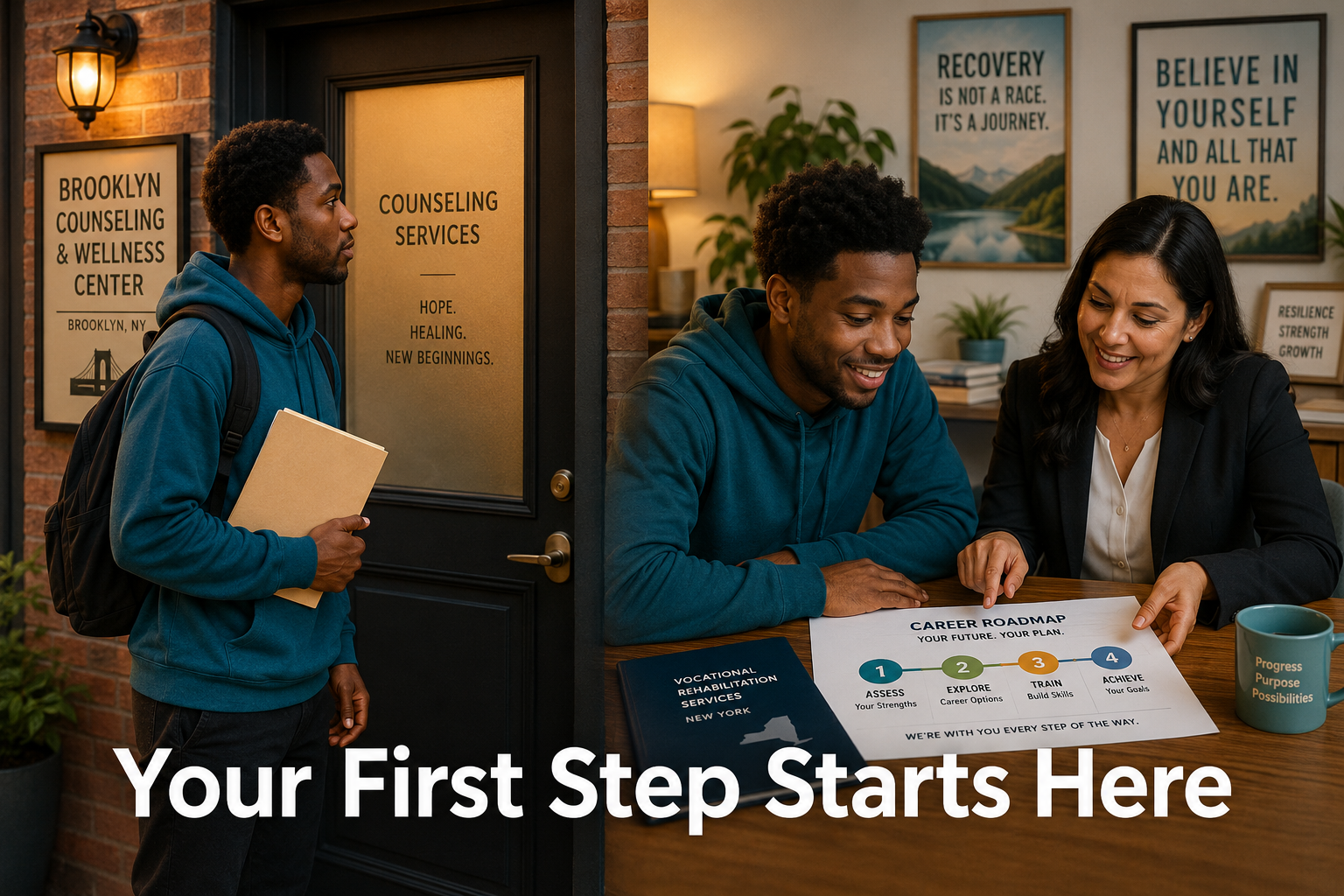
What Happens in Your First Career Counselor Meeting?
The Meeting Is a Two-Way Conversation
One of the biggest misconceptions people have is that a career counselor will hand them a list of jobs and send them on their way. That’s not how it works. Your first session is a structured conversation, a chance for both you and the counselor to understand each other.
A qualified vocational rehabilitation specialist in New York is trained to listen deeply. They’re not there to judge your past employment gaps, your criminal record, or the fact that addiction may have disrupted your work history. They’re there to help you build forward.
Expect the counselor to:
- Introduce themselves and explain how the process works
- Ask open-ended questions about your background, interests, and goals
- Create a safe space for honest, stigma-free dialogue
- Explain confidentiality so you know your information is protected
What You’ll Be Asked About
During your first meeting, a vocational rehabilitation counselor will typically explore several areas of your life. This helps them know not just what jobs might fit you, but what kind of support you need to get there.
Here’s a general breakdown of topics covered:
| Topic | Why It Matters |
|---|---|
| Work history & education | Identifies transferable skills and gaps |
| Personal strengths & interests | Points toward fulfilling career paths |
| Challenges and barriers | Helps plan realistic, achievable steps |
| Short-term and long-term goals | Guides the direction of counseling |
| Support systems | Assesses what’s already in place |
| Health and recovery status | Ensures the plan fits your current capacity |
You don’t need to have all the answers. In fact, not knowing is exactly why you’re there. Comprehending what a vocational rehabilitation counselor does can help ease the pressure before you walk in the door.
How to Prepare for Your First Session
Preparation makes a real difference. You don’t need a polished resume or a five-year plan. You just need to show up with a willingness to be honest and open. Here are some practical ways to get ready:
Before your appointment:
- ✅ Write down 2-3 things you’ve been good at in past jobs or life experiences
- ✅ Think about what kind of work environment makes you feel comfortable
- ✅ Note any barriers you’re facing, transportation, childcare, legal history, health
- ✅ Bring any documents you have: ID, resume, GED or diploma if available
- ✅ Reflect on what motivates you, not just money, but purpose
Being transparent about your substance use history, if relevant, is also encouraged. Many vocational rehabilitation specialists in New York work regularly with people in recovery and comprehend the unique challenges involved. Your honesty allows them to tailor their guidance to your real situation, not an idealized version of it.
Building Your Action Plan With a Vocational Rehabilitation Specialist in New York
What Comes Out of the First Meeting
By the end of your first session, or shortly after, you and your counselor will typically have the foundation of a personalized action plan. This is a roadmap that outlines:
- Short-term steps (e.g., updating your resume, enrolling in a training program)
- Medium-term goals (e.g., completing a certification, applying for jobs in a specific field)
- Long-term vision (e.g., stable employment in a career that supports your recovery lifestyle)
The plan is not set in stone. Life changes, and your counselor will adjust it with you. What matters is that it’s yours, built around your strengths, your pace, and your goals.
If you’re curious about which fields offer the most opportunity, exploring the 5 most in-demand vocational careers for the future can give you a helpful starting point before or after your first meeting.

The Role of Active Participation
Here’s something many people don’t expect: your engagement is the most important factor in whether counseling works. A vocational rehabilitation specialist in New York can open doors, identify resources, and map out a path, but you have to walk it.
This means:
- Showing up to follow-up appointments
- Completing any tasks or applications discussed
- Being open to feedback, even when it challenges your assumptions
- Asking questions when you don’t comprehend something
Active participation isn’t about being perfect. It’s about being present and honest. Even if you miss a step or hit a setback, a good counselor will help you recalibrate, not shame you for stumbling.
How Vocational Services Fit Into Recovery at LSA Recovery
At LSA Recovery Inc., vocational support doesn’t exist in a vacuum. It’s part of a comprehensive, whole-person treatment model that addresses addiction, mental health, and life skills together.
Our Care Management services connect clients with employment resources while also supporting their broader medical and social needs. For clients dealing with both substance use and mental health conditions, our MICA Program provides specialized support that addresses both issues simultaneously, because stability in one area of life supports stability in all others.
For those who want to know how to choose the right vocational training for their career goals, our counselors can walk you through options that align with your recovery timeline and personal strengths.
We also recognize that some clients face additional barriers, including involvement with the criminal justice system or ACS. Our team is experienced in working with these situations with full respect and no judgment. Comprehending what qualifications are needed for vocational rehabilitation can also help you know what to expect from the process.
What Makes a Good Vocational Rehabilitation Specialist?
Not all career counselors are the same. When working with a vocational rehabilitation specialist in New York, look for someone who:
- 🎓 Holds a master’s degree in counseling or a related field
- 📋 Has experience with populations in recovery or with co-occurring conditions
- 🤝 Practices a collaborative, non-directive style, guiding rather than dictating
- 🌍 Understands the cultural and economic realities of your community
- 💬 Communicates clearly and makes you feel heard and respected
At LSA Recovery, our multicultural team serves Brooklyn’s diverse communities in English, Spanish, Russian, and Ukrainian.
After the First Meeting: What’s Next?
Your first session is just the beginning. Here’s what typically follows:
- Follow-up appointments to review progress and adjust the plan
- Referrals to training programs, job placement services, or educational resources
- Coordination with other services at LSA Recovery, including counseling and care management
- Ongoing support as you navigate job applications, interviews, and workplace challenges
The process of vocational rehab in New York varies by individual, but having consistent support dramatically improves outcomes. Recovery and employment reinforce each other, stable work supports sobriety, and sobriety supports stable work.
FAQs:
Do I need to be fully sober before meeting with a vocational rehabilitation specialist in New York?
No. You don’t need to be at any particular stage of recovery to start vocational counseling. In fact, beginning to think about career goals during treatment can be a powerful motivator. At LSA Recovery, our vocational counselors work alongside your treatment team to ensure the timing and pace of career planning fits your recovery journey.
What if I have a criminal record or gaps in my work history?
This is more common than you might think, and a good vocational rehabilitation specialist in New York is trained to work with exactly these situations. Your counselor will help you identify transferable skills, address potential employer concerns honestly, and connect you with employers and programs that are open to hiring people with varied histories.
Is vocational counseling covered by Medicaid or Medicare?
At LSA Recovery, Medicaid, Medicare, and most insurances are accepted for our treatment and support services. We also have insurance representatives on staff to assist those who are still in the process of obtaining coverage.
What if I don’t know what career I want?
That’s completely okay, and it’s one of the most common things counselors hear. Your first meeting is partly designed to help you discover what you want. Through conversation, assessments, and exploration of your interests and strengths, a vocational rehabilitation specialist in New York will help you begin to narrow down options that feel realistic and meaningful.
References
- U.S. Bureau of Labor Statistics. (2022). School and Career Counselors and Advisors: Occupational Outlook Handbook. U.S. Department of Labor. https://www.bls.gov/ooh/community-and-social-service/school-and-career-counselors.htm
- Substance Abuse and Mental Health Services Administration (SAMHSA). (2023). Key Substance Use and Mental Health Indicators in the United States: Results from the 2022 National Survey on Drug Use and Health. U.S. Department of Health and Human Services. https://www.samhsa.gov/data/report/2022-nsduh-annual-national-report
- National Institute on Drug Abuse (NIDA). (2022). Principles of Drug Addiction Treatment: A Research-Based Guide (Third Edition). National Institutes of Health. https://nida.nih.gov/publications/principles-drug-addiction-treatment-research-based-guide-third-edition
The Difference Between Greening Out and THC Panic Attack: What You Need to Know
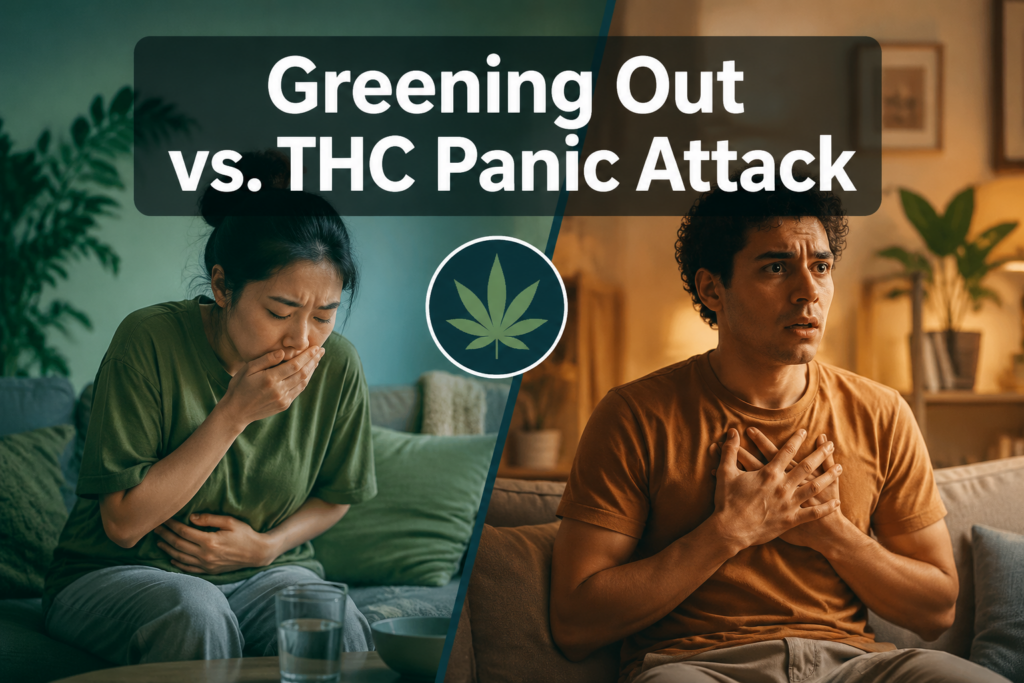
Nearly 1 in 5 cannabis users will experience a distressing reaction at some point, yet most people have no idea whether what they’re going through is a physical crisis, a mental health episode, or both. comprehending the difference between greening out and a THC panic attack could be the most important thing you read today, especially as cannabis products grow stronger and more widely available across New York.
These two experiences are often confused, and that confusion matters. One is primarily a physical overdose response. The other is primarily a psychological anxiety reaction. Both are real, both are scary, and both can be warning signs of a deeper relationship with cannabis that deserves attention.
Learn more with Expert Support for Substance Use in Brooklyn, NY.
Key Takeaways 🌿
- Greening out = a physical cannabis toxicity response (nausea, vomiting, dizziness, pallor)
- THC panic attack = a psychological anxiety response (racing heart, fear, derealization)
- Both can happen at the same time, making them easy to confuse
- Neither is a sign of weakness, both can signal problematic cannabis use
- Professional support is available, effective, and nothing to be ashamed of
Comprehending the Difference Between Greening Out and THC Panic Attack
What Is “Greening Out”?
“Greening out” is informal slang for what clinicians classify as acute cannabis intoxication or an adverse reaction to cannabis. It happens when someone consumes more THC than their body can comfortably process, essentially a cannabis overdose, though not typically life-threatening.
Common physical symptoms include:
- 🤢 Nausea and vomiting
- 😰 Profuse sweating and clamminess
- 😶 Pale or greenish skin tone
- 💫 Dizziness and loss of balance
- 🫀 Rapid or irregular heartbeat
- 🥴 Feeling faint or losing consciousness briefly
The person may feel physically terrible but may not be overwhelmed by fear. They often just want to lie down, stop moving, and wait it out. The body is reacting to a chemical overload, not necessarily a psychological spiral.
Greening out is more common with:
- Edibles (delayed onset leads to accidental overconsumption)
- High-potency concentrates or dabs
- First-time or low-tolerance users
- Mixing cannabis with alcohol
What Is a THC Panic Attack?
A THC panic attack is clinically described as a cannabis-induced anxiety disorder, a panic attack triggered or intensified by THC. Unlike greening out, the dominant experience here is overwhelming psychological fear, not primarily physical illness.
Common symptoms include:
- 😱 Intense, sudden terror or sense of doom
- ❤️ Racing or pounding heartbeat (palpitations)
- 😮💨 Shortness of breath or feeling smothered
- 🧠 Derealization (“this isn’t real”) or depersonalization
- 😨 Fear of dying or “going crazy”
- 🤲 Trembling, tingling, or numbness
THC is known to amplify the brain’s threat-detection systems. In people with underlying anxiety, a genetic predisposition, or past trauma, even a moderate dose can flip a switch from relaxed to terrified within minutes.
Side-by-Side Comparison: Greening Out vs. THC Panic Attack
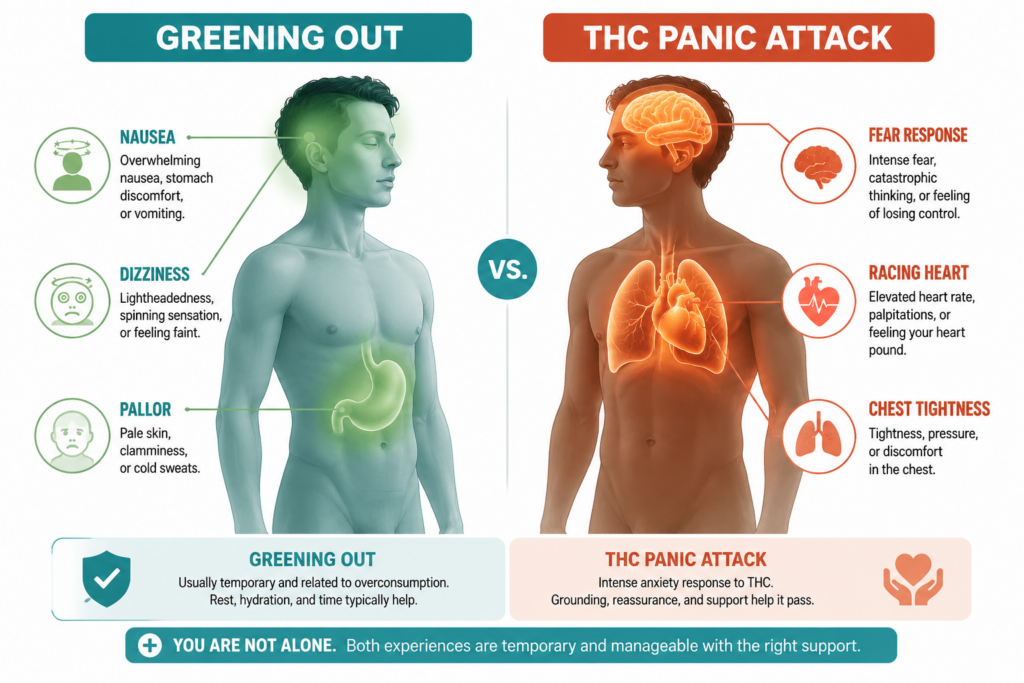
| Feature | Greening Out | THC Panic Attack |
|---|---|---|
| Primary nature | Physical / physiological | Psychological / emotional |
| Main complaint | Nausea, dizziness, vomiting | Fear, doom, derealization |
| Heart racing? | Sometimes | Very common |
| Vomiting? | Very common | Rare |
| Pale/sweaty skin? | Yes | Less typical |
| Sense of terror? | Mild or absent | Severe |
| Clinical term | Cannabis intoxication | Cannabis-induced anxiety disorder |
| Can they overlap? | ✅ Yes, frequently | ✅ Yes, frequently |
Can Both Happen at Once?
Yes, and this is where things get complicated. Many people experience both simultaneously. The physical misery of greening out can trigger panic, and the psychological spiral of a panic attack can worsen physical symptoms like nausea and heart rate. When they overlap, it can feel like a complete breakdown of mind and body.
This overlap is one reason why knowing how substance abuse can lead to mental illness is so important. Cannabis use can genuinely alter anxiety thresholds over time.
Why This Distinction Matters for Your Health
The Risk of Dismissing Either Experience
Both greening out and THC panic attacks are often brushed off as “just weed”, a dangerous minimization. Here’s why both deserve serious attention:
Greening out signals:
- Your body’s tolerance and physical limits are being exceeded
- You may be using higher-potency products than your system can handle
- Repeated episodes can indicate escalating use patterns
THC panic attacks signal:
- Your brain’s anxiety response may be dysregulated
- You may have an underlying anxiety disorder being masked or worsened by cannabis
- Cannabis may be functioning as a coping mechanism for unaddressed stress or trauma
If you’re regularly experiencing either, it’s worth exploring the stages of substance use to understand where your relationship with cannabis currently stands.
When Cannabis Use Becomes a Co-Occurring Issue 🔍
For many people, cannabis use doesn’t exist in a vacuum. It often co-occurs with anxiety disorders, depression, PTSD, or other mental health conditions. This is sometimes called a dual diagnosis or MICA (Mentally Ill Chemical Abuser) presentation.
Comprehending what MICA means in mental health can help people recognize that their cannabis-related distress may be part of a larger picture that deserves integrated, compassionate care.
What to Do During a Greening Out or THC Panic Attack
Immediate Steps for Greening Out
- Stop consuming, no more cannabis, no alcohol
- Lie down in a safe, quiet space
- Hydrate slowly, small sips of water or juice
- Eat something light if possible (sugar can help)
- Stay with someone you trust
- Call 911 if the person loses consciousness or can’t be roused
Immediate Steps for a THC Panic Attack
- Ground yourself, name 5 things you can see, 4 you can touch
- Breathe slowly, inhale for 4 counts, exhale for 6
- Remind yourself, “This is THC. It will pass. I am not dying.”
- Move to a calm environment, reduce stimulation
- Talk to someone, a calm, trusted voice helps enormously
- Seek emergency care if symptoms don’t subside or feel medically serious
The Difference Between Greening Out and THC Panic Attack: Long-Term Patterns to Watch
When Occasional Episodes Become a Pattern
A single bad experience with cannabis doesn’t define your relationship with it. But when these episodes happen repeatedly, or when you find yourself using cannabis to manage anxiety that cannabis itself is worsening, that cycle is worth examining honestly.
Signs that a pattern may be developing:
- Using cannabis daily to feel “normal” or calm
- Needing more to get the same effect (tolerance)
- Greening out more than once
- Panic attacks that happen even when sober
- Using cannabis to cope with trauma, stress, or emotional pain
Cannabis Detox: What to Expect
If you’ve decided to take a break or stop altogether, it helps to know what the process looks like. Knowing how long it takes to detox from cannabis can reduce anxiety about the withdrawal process and help you plan with realistic expectations.
Getting Support in Brooklyn: You Don’t Have to Figure This Out Alone
If any of this resonates, whether you’ve had a frightening greening out episode, recurring THC panic attacks, or you’re just questioning your relationship with cannabis, support is closer than you think.
At LSA Recovery Inc., we offer compassionate, stigma-free outpatient treatment for cannabis use and co-occurring mental health conditions across three Brooklyn locations:
- 📍 Midwood (Kings Highway): 1623 Kings Hwy, Brooklyn, NY 11229, ☎️ (718) 954-3800
- 📍 Crown Heights: 921 E New York Ave, Brooklyn, NY 11203, ☎️ (718) 684-7774
- 📍 Coney Island: 2846 Stillwell Ave, Brooklyn, NY 11224, ☎️ (718) 975-2252
Our MICA program is specifically designed for people navigating both substance use and mental health challenges, because those two things almost always travel together. We also offer individual, family, and group counseling, substance use education, and care management to support every dimension of your recovery.
Same-day appointments are available. Telehealth options are available. Medicaid, Medicare, and most insurances accepted, and our insurance representatives can help if you’re still in the process of getting coverage.
FAQs:
Can greening out cause lasting physical harm?
In most cases, greening out resolves on its own within a few hours without permanent physical damage. Nonetheless severe vomiting can lead to dehydration, and in rare cases, very high THC doses have been associated with cannabinoid hyperemesis syndrome (CHS) a condition involving cyclical, severe vomiting. If symptoms are extreme or don’t resolve, seek emergency medical care.
Does having a THC panic attack mean I have an anxiety disorder?
Not necessarily, but it’s worth exploring. THC can trigger panic responses even in people without a clinical anxiety disorder, especially with high-potency products. Nevertheless, if panic attacks happen frequently, occur outside of cannabis use, or significantly disrupt your daily life, a proper mental health evaluation is strongly recommended.
Is cannabis use disorder a real diagnosis?
Yes. Cannabis use disorder (CUD) is a recognized clinical diagnosis in the DSM-5. It involves continued cannabis use despite negative consequences, tolerance, withdrawal symptoms, and difficulty cutting back. It exists on a spectrum from mild to severe. Recognizing it is not about shame, it’s about accessing the right level of support.
How do I know if I need professional help for cannabis-related anxiety?
Consider reaching out if: your cannabis use feels out of control, you’re using it primarily to manage anxiety or emotional pain, you’ve had multiple greening out or panic episodes, or your mental health has worsened alongside your use. You don’t need to hit a “rock bottom” to deserve support.
References
- Substance Abuse and Mental Health Services Administration (SAMHSA). (2023). Key substance use and mental health indicators in the United States: Results from the 2022 National Survey on Drug Use and Health. U.S. Department of Health and Human Services. https://www.samhsa.gov/data/report/2022-nsduh-annual-national-report
- National Institute on Drug Abuse (NIDA). (2024). Cannabis (marijuana) DrugFacts. National Institutes of Health. https://nida.nih.gov/publications/drugfacts/cannabis-marijuana
- Centers for Disease Control and Prevention (CDC). (2023). Health effects of marijuana. U.S. Department of Health and Human Services. https://www.cdc.gov/marijuana/health-effects/index.html
- American Psychiatric Association. (2022). Diagnostic and statistical manual of mental disorders (5th ed., text revision). https://www.psychiatry.org/psychiatrists/practice/dsm
- National Alliance on Mental Illness (NAMI). (2023). Marijuana and mental health. https://www.nami.org/About-Mental-Illness/Common-with-Mental-Illness/Substance-Use-Disorders
Expert Support for Substance Use in Brooklyn, NY: Your Complete Guide to LSA Recovery

Nearly 1 in 7 Americans will develop a substance use disorder at some point in their lives, yet fewer than 1 in 10 ever receive treatment. In Brooklyn, a borough of more than 2.5 million people, that gap between need and care is felt every single day. If you or someone you love is struggling, finding expert support for substance use is not a sign of weakness. It is one of the most courageous decisions a person can make.
At LSA Recovery Inc., Brooklyn residents have access to a medically supervised, compassionate outpatient program built around one belief: every person deserves a path to recovery that is free of shame, judgment, and blame. This guide walks you through what that support looks like, who it serves, and how to take the first step.
Start with Expert Support for Substance Use in Brooklyn, NY.
Key Takeaways 🗝️
- Expert support for substance use is available in Brooklyn through LSA Recovery’s three outpatient locations in Midwood, Crown Heights, and Coney Island.
- Services range from individual counseling and Medication-Assisted Treatment (MAT) to family therapy, crisis management, and vocational support.
- Same-day appointments, telehealth options, and multilingual staff make care accessible to nearly everyone.
- Medicaid, Medicare, and most insurances are accepted, with on-staff insurance representatives to help.
- Recovery is a personal journey; LSA Recovery supports all paths, including harm reduction.
Why Expert Support for Substance Use Matters in Brooklyn
Substance use disorders do not discriminate. They affect people of every age, background, income level, and zip code. In Brooklyn’s dense, diverse communities, the pressures of poverty, trauma, housing instability, and systemic inequality can all increase vulnerability to chemical dependency.
“Addiction is often rooted in trauma, not a lack of willpower.”
Comprehending this is the foundation of effective care. When someone receives expert support for substance use from trained professionals who see the whole person, not just the substance, recovery becomes not just possible, but sustainable.
Here is a quick look at why professional outpatient treatment makes a real difference:
| Without Treatment | With Expert Support |
|---|---|
| Cycles of relapse without tools to break them | Evidence-based strategies to manage triggers |
| Isolation and shame | Community, counseling, and connection |
| Untreated co-occurring mental health issues | Integrated dual-diagnosis care |
| Limited access to medical support | Medication-Assisted Treatment (MAT) available |
| Navigating systems alone | Care managers to coordinate all support |
If you want to understand more about what the recovery process looks like from the beginning, our guide to understanding the 5 stages of substance abuse is a helpful starting point.
Who Does LSA Recovery Serve?
LSA Recovery’s doors are open to a wide range of individuals, including:
- ✅ Adults struggling with alcohol, opioids, or other substance use disorders
- ✅ Individuals with co-occurring mental health conditions (MICA)
- ✅ Family members and loved ones of people in active addiction
- ✅ People involved in the criminal justice system
- ✅ Parents and caretakers referred through NYC’s Administration of Children’s Services (ACS)
- ✅ Anyone referred through DWI/DUI programs
- ✅ People of all insurance statuses, including those still obtaining coverage
Programs are conducted in English, Spanish, Russian, and Ukrainian, reflecting the rich diversity of Brooklyn’s communities.
A Full Spectrum of Expert Support for Substance Use
One of LSA Recovery’s greatest strengths is the breadth of its services. Rather than a one-size-fits-all approach, every client receives a customized treatment plan built around their specific needs, history, and goals.
🔍 Comprehensive Assessment
Every journey begins with an honest, non-judgmental evaluation. LSA’s experienced counselors conduct thorough substance use assessments to determine the right level of care and the most effective treatment path. You can also read our essential guide to substance abuse evaluations for recovery to know what to expect before your first appointment.
🧠 Individual, Family & Group Counseling
Healing rarely happens in isolation. LSA offers evidence-based counseling in three formats:
- Individual counseling . One-on-one sessions to explore personal history, triggers, and goals
- Family therapy . Rebuilding relationships and communication with loved ones
- Group therapy . Peer support that reduces isolation and builds community
Research consistently shows that group therapy supports long-term recovery by creating accountability and shared comprehension. Family sessions are equally powerful, learn more about LSA’s family therapy services in Brooklyn.
💊 Medication-Assisted Treatment (MAT) for Opioid Addiction
For individuals recovering from opioid addiction, Medication-Assisted Treatment is one of the most evidence-based tools available. MAT combines FDA-approved medications with counseling to reduce cravings, prevent withdrawal, and support sustained recovery. It is not a crutch, it is proven medicine.
🤝 Care Management
Recovery involves more than just treatment sessions. LSA’s care managers assess the full range of a patient’s needs, from housing and healthcare coordination to social services, and serve as a consistent point of contact throughout the recovery process. For more on how to access this kind of support, see our guide on how to access a mental health case manager.
🧩 MICA Program: Dual Diagnosis Support
Many people struggling with substance use also live with mental health conditions like depression, anxiety, PTSD, or bipolar disorder. LSA’s MICA Program (Mentally Ill Chemical Abuser) is specifically designed for individuals facing both challenges at once. Comprehending how substance abuse can lead to mental illness is critical to effective treatment.
LSA Recovery is also affiliated with Interborough Developmental & Consultation Center, a full mental health provider, allowing for seamless referrals when additional behavioral health support is needed.
🚨 Crisis Management
When someone is in acute crisis, they need immediate, compassionate support. LSA’s crisis management services provide short-term stabilization tools to help clients navigate emergencies safely without judgment.
📚 Additional Services at a Glance
| Service | Who It Helps |
|---|---|
| Substance Use Education | Clients learning to understand triggers and build drug-free living skills |
| Criminal Justice Counseling | Individuals navigating the legal system alongside recovery |
| DWI Program | Those charged with DWI/DUI infractions |
| ACS Program | Parents/caretakers referred through NYC’s child welfare system |
| Naloxone Training & Kits | Anyone at risk of opioid overdose or caring for someone who is |
| ACRA & CRAFT Program | Families trying to support a loved one who refuses treatment |
| Education & Vocational Services | Clients rebuilding careers and financial independence |
| HIV/AIDS Education | Prevention, risk reduction, and support for those diagnosed |
| Health Education Groups | Knowing how addiction impacts overall health |
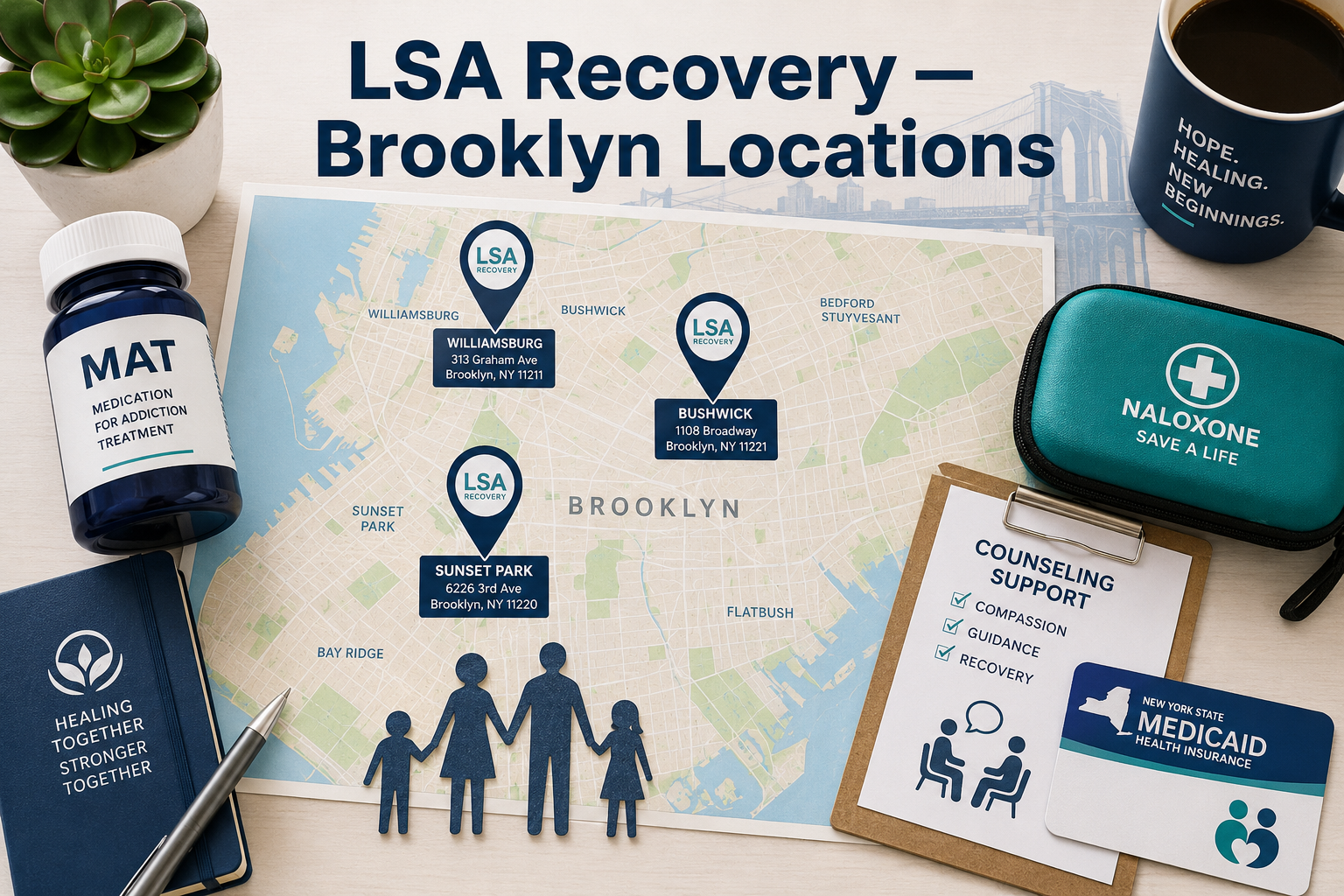
Three Convenient Locations Across Brooklyn
LSA Recovery operates three outpatient locations to serve Brooklyn’s communities where they live.
📍 Midwood (Kings Highway)
1623 Kings Hwy, Brooklyn, NY 11229
📞 (718) 954-3800
Located within 2 blocks of the Q and B trains to Kings Highway, and accessible via the B7, B82, B68 & B100 bus lines.
Hours: Mon, Wed, Thu: 8:30 AM–8:00 PM | Tue: 8:30 AM–5:00 PM | Sun: 9:00 AM–5:00 PM
📍 Crown Heights
921 E New York Ave, Brooklyn, NY 11203
📞 (718) 684-7774
Hours: Mon: 9:00 AM–8:00 PM | Tue–Thu: 9:00 AM–5:00 PM
📍 Coney Island
2846 Stillwell Ave, Brooklyn, NY 11224
📞 (718) 975-2252
Hours: Tue & Thu: 9:00 AM–8:00 PM | Mon, Wed: 9:00 AM–5:00 PM
Telehealth appointments are available Monday–Thursday from 7:00 AM–11:00 PM and Sunday from 9:00 AM–7:00 PM, making expert support accessible even when getting to an office is difficult.
Insurance & Access: No Barrier Should Stand in the Way
One of the most common reasons people delay seeking help is fear about cost. LSA Recovery accepts Medicaid, Medicare, and most private insurance plans. For those who are still in the process of obtaining coverage, insurance representatives are on staff to help navigate the system.
Same-day appointments are available. There is no reason to wait.
📧 Email: [email protected]
🌐 Book online: lsarecovery.org/contact-us
Your Recovery Starts With One Step
In 2026, the conversation around substance use is changing. More people are recognizing that addiction is a medical condition, one that responds to compassionate, evidence-based care. Brooklyn has the resources, and LSA Recovery Inc. is here to provide the expert support for substance use that you or your loved one deserves.
Here are your actionable next steps:
- 📞 Call the LSA Recovery location nearest to you , same-day appointments are available.
- 🌐 Visit lsarecovery.org/contact-us to book an appointment online.
- 📋 Start with a comprehensive assessment , no commitment, no judgment, just honest guidance.
- 💬 Bring a family member , recovery is stronger when loved ones are involved.
- 🛡️ Ask about insurance , an on-staff representative can help you figure out your coverage today.
Recovery is not a straight line, and there is no single right path. What matters is that you take the first step, and that you do not take it alone.
Is Naltrexone the Same as Naloxone? A Clear Guide for Patients and Family Members
They sound identical, but confusing these two medications could be a matter of life or death. When navigating addiction, families constantly ask: Is naltrexone the same as naloxone? One acts as a daily shield for long-term sobriety, while the other is a rapid emergency lifesaver. Uncover the crucial differences in this guide to ensure you know exactly which one to use before it matters most.
Access knowledge via Naloxone Training
TL;DR:
Naltrexone is a non-addictive medication used to treat opioid and alcohol use disorders by actively blocking the brain’s opioid receptors, which suppresses cravings and neutralizes the euphoric effects of substance use. Available in either a daily oral form or a monthly extended-release injection, the medication is most effective when utilized as part of a comprehensive recovery plan that includes behavioral counseling and peer support. To avoid triggering sudden and severe withdrawal symptoms, patients must be completely opioid-free for 7 to 14 days before initiating treatment.

What is Naltrexone and How does it Work?
Naltrexone is a medication commonly utilized in the treatment of opioid use disorder (OUD) and alcohol use disorder (AUD). It belongs to a class of medications known as opioid antagonists, which means it works by actively blocking opioid receptors in the brain. Unlike opioid medications, naltrexone does not produce euphoric or sedative effects, nor is it considered addictive. It is typically utilized as one component of a broader, comprehensive recovery plan that includes counseling, behavioral therapy, and ongoing medical support.
The medication functions by attaching to opioid receptors without actually activating them. This prevents opioids from producing the pleasurable effects that drive misuse and dependence. National mental health and substance abuse authorities note that naltrexone can effectively reduce cravings and support long-term recovery outcomes. Furthermore, clinical research indicates that when combined with comprehensive care, medications for opioid use disorder improve treatment retention and reduce the risk of overdose.
Naltrexone is also widely used for alcohol dependence. Studies suggest that by blocking opioid pathways, the medication reduces the rewarding sensations associated with alcohol consumption, which helps individuals decrease heavy drinking episodes and maintain sobriety. Because introducing naltrexone while opioids are still in the body can trigger sudden and severe withdrawal symptoms, medical professionals strongly recommend using it under careful supervision, ensuring the patient is completely opioid-free before beginning treatment.
Blocking Opioid Receptors to Prevent Effects
One of naltrexone’s primary functions is its ability to block the brain’s mu-opioid receptors, which are responsible for producing feelings of pain relief and euphoria. If an individual takes opioids while naltrexone is active in their system, the medication prevents those substances from binding effectively to the receptors. As a result, the user does not experience the pleasurable “high” that reinforces continued opioid misuse.
This blocking action is a vital component of relapse prevention. Because the medication interrupts the cycle of reinforcement by neutralizing the euphoric and sedative effects of opioids, individuals recovering from addiction may be less likely to continue using them.
It is important to note that naltrexone differs from medications like methadone or buprenorphine because it blocks opioid activity rather than replacing opioids. Naltrexone does not cause physical dependence, and stopping it does not typically result in withdrawal symptoms.
Reducing Cravings and Risk of Relapse
Cravings represent one of the most significant challenges in addiction recovery, as the brain continues to associate substances with pleasure and emotional relief. Naltrexone is frequently used to suppress these cravings and lower the risk of relapse. By blocking opioid receptors, it reduces the rewarding sensations tied to substance use, helping to decrease the urge to use again.
Public health and substance abuse authorities view naltrexone as a valuable tool for individuals who have completed detoxification and are committed to maintaining their recovery. Healthcare providers frequently incorporate it into long-term relapse prevention plans because combining medication-assisted treatment with behavioral support tends to decrease relapse rates.
- Overdose Vulnerability: Relapse prevention is particularly critical because patients who discontinue naltrexone and return to opioid use are highly vulnerable to overdose. This heightened risk occurs because the body’s opioid tolerance significantly drops during a period of abstinence.
- Improving Engagement: To improve treatment engagement, recent federally supported clinical trials have explored faster initiation protocols for extended-release injectable naltrexone, demonstrating ongoing efforts to make recovery treatments more accessible and effective.
Supporting Long-Term Recovery Treatment
Addiction is a chronic medical condition that often involves periods of relapse and recovery, meaning long-term success requires more than just short-term detoxification. Naltrexone is commonly integrated into a “whole-patient approach” designed to address both the psychological and physical aspects of addiction. This helps individuals maintain abstinence while they actively develop healthier coping strategies and lifestyle changes.
Healthcare professionals frequently pair naltrexone with mental health services, peer support, and family counseling. This integrated model helps individuals rebuild their routines, relationships, and emotional stability. Research shows that medication-based approaches for opioid use disorder can reduce overdose deaths, improve treatment retention, decrease behaviors linked to infectious disease transmission, and support overall quality of life, including employment and family functioning.
Administering Oral or Injectable Forms
Naltrexone is available in two formulations, allowing providers to tailor the treatment to a patient’s specific recovery goals. The choice between oral and injectable forms is based on the patient’s medical history, access to treatment, and personal preference. Recent clinical studies also suggest that accelerating the initiation of the injectable form (beginning within five to seven days of seeking care) may improve treatment success compared to longer waiting periods, though it requires enhanced medical oversight.
| Formulation Type | Administration & Frequency | Considerations & Best Use |
| Oral Form | Typically taken once daily. | Common for alcohol dependence treatment. Appropriate for individuals who can consistently maintain a daily schedule. Missing doses increases the risk of relapse. |
| Extended-Release Injectable | Administered by a professional approximately once every four weeks. | Approved for both opioid and alcohol use disorders. Removes the need for daily dosing decisions, improving overall treatment consistency. |
Monitoring Use Under Medical Supervision
Given the risks associated with early initiation, medical supervision is a critical component of naltrexone treatment. Before starting, patients undergo an evaluation, which may include urine drug screenings or a naloxone challenge test, to confirm that their body is completely free of opioids.
General health guidelines advise waiting at least seven days after using short-acting opioids, and up to 10 to 14 days after using long-acting opioids, before taking naltrexone. Starting too soon can trigger severe withdrawal symptoms requiring immediate medical intervention.
Ongoing monitoring allows healthcare teams to manage side effects, track recovery progress, and monitor liver function and mental health. A vital part of this supervision involves educating patients about their lost opioid tolerance and the severe overdose risk if they relapse after stopping the medication. By addressing the individual’s overall physical, social, and emotional needs through continuous monitoring and coordinated counseling, healthcare providers can greatly reduce the likelihood of future relapse and support lasting recovery.
Key Takeaways:
- Mechanism of Action and Cravings: Naltrexone is a non-addictive medication used to treat opioid and alcohol use disorders by actively blocking the brain’s mu-opioid receptors. By neutralizing the euphoric and sedative effects of these substances, it effectively suppresses intense cravings and interrupts the cycle of reinforcement to prevent relapse.
- The Necessity of Prior Detoxification: Patients must be completely opioid-free for 7 to 14 days before beginning naltrexone, as starting the medication too early can trigger sudden, severe withdrawal symptoms. Because of this inherent biological risk, initiating the treatment requires strict medical supervision and pre-evaluations like urine screenings.
- Integrated Long-Term Recovery: Addiction is a chronic condition that requires a “whole-patient approach,” meaning naltrexone is most effective when combined with comprehensive behavioral support. Pairing the medication with mental health services, peer support, and family counseling helps individuals maintain abstinence while rebuilding their routines and emotional stability.
- Adaptable Administration Options: Treatment can be tailored to a patient’s needs through either a daily oral pill or a monthly extended-release injection. While the daily oral form requires strict adherence to remain effective, the injectable option removes daily dosing decisions and significantly improves overall treatment consistency.
- Overdose Vulnerability and Monitoring: Continuous medical supervision is crucial to manage side effects, track progress, and educate patients on their significantly lowered opioid tolerance during recovery. This education is a matter of life or death, as relapsing after a period of naltrexone-assisted abstinence carries a severely heightened risk of fatal overdose.
FAQs:
What is naltrexone?
Naltrexone is a non-addictive medication commonly utilized to treat opioid use disorder (OUD) and alcohol use disorder (AUD). As an opioid antagonist, it works by actively attaching to and blocking opioid receptors in the brain, effectively preventing substances from producing the pleasurable, euphoric, or sedative effects that drive misuse.
What is the difference between naloxone and naltrexone?
While their names sound identical, confusing the two can be a matter of life or death because they serve entirely different roles in addiction management. The text distinguishes them by noting that one medication acts as a daily shield to help maintain long-term sobriety, while the other is utilized as a rapid emergency lifesaver.
What is naloxone?
Naloxone is a medication utilized as a rapid emergency lifesaver. Additionally, healthcare providers use it in a “naloxone challenge test” during a patient’s initial evaluation to confirm that their body is completely free of opioids before they begin other treatments.
What are naloxone and naltrexone used for?
Naltrexone is used to treat opioid use disorder (OUD) and alcohol use disorder (AUD) by acting as a daily shield to support long-term sobriety. It works by actively blocking opioid receptors in the brain to reduce cravings and prevent the pleasurable effects that drive misuse. In contrast, naloxone is used as a rapid emergency lifesaver and is also administered in clinical challenge tests to ensure a patient is entirely opioid-free before starting naltrexone therapy.
Sources.
National Institutes of Health. (2024, March 22). Faster approach for starting extended-release naltrexone to treat opioid use disorder shown effective. U.S. Department of Health and Human Services. https://www.nih.gov/news-events/news-releases/faster-approach-starting-extended-release-naltrexone-treat-opioid-use-disorder-shown-effective
Centers for Disease Control and Prevention. (2024, May 15). Recovery is possible: Treatment for opioid addiction. U.S. Department of Health and Human Services. CDC Overdose Prevention Page
You May Also Like:
Can You Overdose on Narcan? Risks and Facts Explained
Living with Chronic HIV Anxiety: How to Regain Your Quality of Life
You’ve taken the tests and heard the medical reassurances, yet the fear continues to dictate your every waking moment. Why does the mind refuse to let go even when the body is safe? This relentless cycle is exhausting, but a way out exists. Explore Living with Chronic HIV Anxiety: How to Regain Your Quality of Life and discover how professional HIV/AIDS training can finally help you break the loop.
Get informed with HIV/AIDS training
TL;DR:
Chronic HIV-related anxiety is an exhausting cycle fueled by the profound fear of a positive diagnosis, societal stigma, and a lack of accurate medical education. Sufferers frequently misinterpret normal, anxiety-induced physical symptoms as signs of infection and resort to compulsive reassurance-seeking, such as repetitive testing, which ultimately reinforces their fear rather than resolving it. Breaking this debilitating loop requires addressing the underlying psychological distress directly and replacing outdated myths with clear, evidence-based information.

What Causes Chronic HIV-related Anxiety?
Dealing with persistent worries about your health can be incredibly exhausting. Chronic HIV-related anxiety develops when fear about HIV becomes overwhelming and difficult to control over time. This heavy burden can affect people living with HIV, those waiting for test results, or even individuals who constantly worry about exposure despite receiving repeated negative tests and medical reassurance.
Often, this anxiety goes far beyond medical concerns, intertwining with deep emotional distress, social stigma, uncertainty, and misinformation. Research highlights that this intense worry can severely interfere with daily life, relationships, sleep, and overall well-being. Without the right support and accurate information, this cycle of fear can unfortunately last for months or even years.
Fear of Diagnosis and Health Uncertainty
One of the primary drivers of this anxiety is the profound fear of receiving a positive diagnosis or simply living with uncertainty about your health status. Health uncertainty is emotionally draining; waiting periods, confusion about risk levels, and catastrophic thinking can trigger a surge in stress hormones and disrupt sleep.
- Catastrophic Thinking: Even before a test is taken, many people experience intense worry about what an HIV diagnosis could mean for their future, relationships, and quality of life.
- Information Gaps: This fear is frequently magnified when individuals are unfamiliar with modern HIV treatments or when they rely on outdated information.
- Symptom Searching: While modern treatments have drastically improved long-term outcomes, constant worry can create a cycle where the uncertainty itself becomes the main source of distress, particularly if someone spends excessive time searching for symptoms online.
Stigma and Social Judgment Concerns
The fear of social judgment is a heavy weight to carry. Many individuals fear being judged, rejected, or discriminated against due to the cultural beliefs and negative public attitudes historically associated with HIV. This fear can be profound even for those who have never been diagnosed.
| Impact Area | Clinical Consequence |
| Shame and Isolation | Public health organizations note that the stigma surrounding HIV can lead to deep feelings of shame and isolation. |
| Healthcare Avoidance | It can actively discourage people from seeking healthcare, getting tested, or openly discussing their sexual health. |
| Testing Anxiety | Recent qualitative studies highlight that this fear of judgment and concerns about confidentiality significantly drive testing anxiety. Sadly, when stigma goes unaddressed, the emotional fear of judgment can persist long after a negative test result or successful treatment. |
Misinterpretation of Physical Symptoms
It is incredibly common for health anxiety to make you hyper-focused on your body. Anxiety itself can produce a wide range of physical symptoms, such as fatigue, sweating, headaches, nausea, muscle tension, dizziness, and sleep disturbances. Unfortunately, people often misinterpret these normal stress responses or minor unrelated illnesses as signs of an HIV infection.
Mental health research shows that anxiety disorders heighten our attention to perceived physical danger. This creates a vicious, reinforcing cycle: anxiety causes physical symptoms, and those physical symptoms in turn spike your anxiety.
Internet searches often worsen the problem by offering broad symptom lists without medical context. It is important to remember that HIV cannot be diagnosed based on symptoms alone.
Repetitive Testing and Reassurance Seeking
When anxiety takes hold, it’s natural to look for a quick way to feel better. This often leads to compulsive reassurance-seeking behaviors, such as taking multiple HIV tests well beyond recommended timelines, constantly checking the body for illness, or repeatedly searching symptoms online.
- Short-Term Relief: A negative test result might offer a brief moment of relief, but the doubts inevitably creep back in. You might start questioning the test’s accuracy or the timing windows.
- Reinforcing Fear: While testing is a vital medical tool, psychological research indicates that excessive reassurance-seeking actually reinforces fear rather than resolving it.
- Daily Disruption: Over time, this repetitive cycle drains your emotional energy and interferes with daily functioning. Healthcare professionals usually recommend addressing the underlying anxiety itself rather than relying on endless testing for temporary comfort.
Ongoing Stress From Lack of Clear Information
A lack of clear, understandable information can cause anxiety to spiral. Outdated beliefs, conflicting online advice, and myths about how HIV is transmitted often lead people to drastically overestimate their actual risk. Confusion regarding testing windows, prevention strategies, and modern treatment outcomes creates a breeding ground for constant doubt.
Without reliable medical communication, people tend to fall back on internet forums or anecdotal stories that only fuel their panic. Public health experts emphasize that clear, evidence-based education is essential.
Comprehending how transmission actually works and how effective modern treatments are can help you distinguish between realistic health concerns and anxiety-driven thoughts, ultimately helping to break the cycle of chronic fear.
Key Takeaways:
- Fear of Diagnosis and Uncertainty: Chronic anxiety is heavily driven by the profound fear of a positive diagnosis and the emotional exhaustion of living with health uncertainty. This distress is frequently amplified by catastrophic thinking and excessive online symptom searching, creating a vicious cycle of worry.
- The Impact of Stigma and Judgment: The persistent fear of social rejection, discrimination, and cultural stigma significantly contributes to deep feelings of shame and emotional isolation. This heavy burden actively discourages individuals from seeking necessary healthcare, openly discussing sexual health, or taking tests.
- Misinterpreting Physical Symptoms: Health anxiety frequently causes normal physical stress responses, such as fatigue, sweating, or muscle tension, to be incorrectly interpreted as definitive signs of an HIV infection. Because anxiety heightens attention to perceived physical danger, it creates a self-reinforcing cycle where panic triggers physical symptoms, which in turn spike further anxiety.
- The Trap of Reassurance Seeking: To temporarily relieve their intense worry, individuals often resort to compulsive reassurance-seeking behaviors, such as taking multiple unnecessary HIV tests or constantly checking their bodies. Psychological research indicates that this continuous cycle actually reinforces long-term fear rather than resolving the underlying uncertainty.
- Ongoing Stress from Misinformation: A severe lack of clear, evidence-based medical information creates a breeding ground for constant doubt and causes individuals to drastically overestimate their actual risk. Outdated beliefs, myths, and conflicting online advice fuel panic instead of offering clarity regarding transmission, testing windows, and modern treatments.
FAQs:
Can HIV trigger anxiety?
Yes, HIV and the profound fear surrounding it can absolutely trigger anxiety. Chronic HIV-related anxiety develops when fears about the condition become overwhelming, affecting individuals living with HIV, those waiting for test results, and even people who constantly worry about exposure despite receiving medical reassurance and negative tests.
How to get over HIV anxiety?
To overcome this anxiety, healthcare professionals advise addressing the root psychological distress directly rather than relying on compulsive behaviors like endless testing, which only offer temporary comfort and ultimately reinforce fear. A critical step in breaking this cycle involves replacing outdated myths with clear, evidence-based medical education.
Is HIV anxiety common?
Yes, research shows that anxiety is a very common experience among people affected by HIV concerns. It is incredibly common for this health anxiety to cause individuals to become hyper-focused on their bodies, leading them to constantly monitor for changes and misinterpret normal stress responses or minor illnesses as signs of an infection.
Can stress worsen HIV?
Anxiety produces a wide range of physical symptoms, such as fatigue, sweating, muscle tension, and sleep disturbances, that individuals mistakenly attribute to an HIV infection. Catastrophic thinking triggers stress hormones that disrupt sleep, creating a vicious, self-reinforcing cycle where physical symptoms and anxiety continually spike one another.
Sources.
Owusu, A.Y. Experiences of new diagnoses among HIV-positive persons: implications for public health. BMC Public Health 22, 538 (2022). https://doi.org/10.1186/s12889-022-12809-6
Iott, B.E., Loveluck, J., Benton, A. et al. The impact of stigma on HIV testing decisions for gay, bisexual, queer and other men who have sex with men: a qualitative study. BMC Public Health 22, 471 (2022). https://doi.org/10.1186/s12889-022-12761-5
Parsons, C. A., & Alden, L. E. (2022). Online reassurance-seeking and relationships with obsessive-compulsive symptoms, shame, and fear of self. Journal of Obsessive-Compulsive and Related Disorders, 33, 100714.
You May Also Like: